

 |
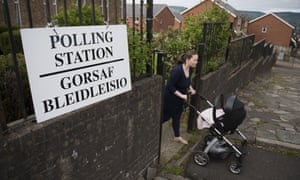
| A voter leaves a polling station at the Elim Pentecostal church in Merthyr Tydfil, south Wales. Photograph: Matthew Horwood/Getty Images |
Brexit is a disaster, but we can build on the ruins
This is a crisis of astonishing
proportions, but also an opportunity for the changes the left has long sought
The Guardian | 28 June 2016
L
et’s sack the electorate and appoint a new
one: this is the demand made
by MPs, lawyers and the 4 million people who have signed the petition
calling for a second referendum. It’s a cry of pain, and therefore
understandable, but it’s also bad politics and bad democracy. Reduced to its
essence, it amounts to graduates telling nongraduates: “We reject your
democratic choice.”
[Related: Britain's Democratic Failure]
Were this vote to be annulled (it won’t be), the result
would be a full-scale class and culture war, riots and perhaps worse, pitching
middle-class progressives against those on whose behalf they have claimed to
speak, and permanently alienating people who have spent their lives feeling
voiceless and powerless.
It has provoked a
resurgence of racism and
an economic crisis whose dimensions remain unknown. It jeopardises the living
world, the NHS, peace
in Ireland and
the rest of the European Union. It promotes what the billionaire Peter
Hargreaves gleefully anticipated as
“fantastic insecurity”.
But we’re stuck with it. There isn’t another option, unless
you favour the years of limbo and chaos that would ensue from a continued
failure to trigger article 50. It’s not just that we have no choice but to
accept the result; we should embrace it and make of it what we can.
It’s not as if the system that’s now crashing around us
was functioning. The vote could be seen as a self-inflicted wound, or it could
be seen as the eruption of an internal wound inflicted over many years by an
economic oligarchy on the poor and the forgotten. The bogus theories on which
our politics and economics are founded were going to collide with reality one
day. The only questions were how and when.
Yes, the Brexit campaign was led by a political elite,
funded by an economic elite and fuelled by a media elite. Yes, popular anger
was channelled towards undeserving targets – migrants.
But the vote was also a howl of rage against exclusion,
alienation and remote authority. That is why the slogan “take back control”
resonated. If the left can’t work with this, what are we for?
So here is where we find ourselves. The economic system
is not working, except for
the likes of Philip Green. Neoliberalism
has not delivered the
meritocratic nirvana its theorists promised, but a rentiers’ paradise, offering
staggering returns to whoever grabs the castle first while leaving productive
workers on the wrong side of the moat.
The age of enterprise has become the age of unearned
income, the age of the market the age of market failure, the age of opportunity
a steel cage of zero-hours contracts, precarity and surveillance.
The political system is not working. Whoever you vote
for, the same people win, because where power claims to be is not where
power is.
Parliaments and councils embody paralysed force, gesture without motion,
as the real decisions are taken elsewhere: by the money, for the money.
Governments have actively conspired in this shift, negotiating
fake trade treaties behind their voters’ backs to prevent
democracy from controlling corporate capital.
Unreformed
political funding ensures
that parties have to listen to the rustle of notes before the bustle of votes.
In Britain these problems are compounded by an electoral system that
ensures most votes don’t count. This is why a referendum is almost the only
means by which people can be heard, and why attempting to override it is a
terrible idea.
Culture is not working. A worldview that insists both
people and place are fungible is inherently hostile to the need for
belonging. For years now we have been told that we do not belong, that we
should shift out without complaint while others are shifted in to take our
place.
When the peculiarities of community and place are swept
away by the tides of capital, all that’s left is a
globalised shopping culture, in which we engage with glazed
passivity. Man was born free, and he is everywhere in chainstores.
In all these crises are opportunities – opportunities to
reject, connect and erect, to build from these ruins a system that works for
the people of this country rather than for an offshore elite that preys on
insecurity.
If it is true that Britain will have to renegotiate its
trade treaties, is this not the best chance we’ve had in decades to contain
corporate power – of insisting that companies that operate here must offer
proper contracts, share their profits, cut their emissions and pay
their taxes? Is it not a chance to regain control of the public services
slipping from our grasp?
How will politics in this sclerotic nation change
without a maelstrom? In this chaos we can, if we are quick and clever, find a
chance to strike a new contract: proportional representation, real devolution
and a
radical reform of campaign finance to
ensure that millionaires can never again own our politics.
Remote authority has been rejected, so let’s use this
moment to root our politics in a common celebration of place, to fight the
epidemic of loneliness and
rekindle common purpose, transcending the tensions between recent and less
recent migrants (which means everyone else). In doing so, we might find a
language in which liberal graduates can talk with the alienated people of Britain,
rather than at them.
But most importantly, let’s address the task that the
left and the centre have catastrophically neglected: developing a political and
economic philosophy fit for the 21st century, rather than repeatedly
microwaving the leftovers of the 20th (neoliberalism and Keynesianism). If the
history of the last 80 years tells us anything, it’s that little changes
without a new and feracious framework of thought.
So yes, despair and rage and curse at what has happened:
there are reasons enough to do so. But then raise your eyes to where hope lies.

No comments:
Post a Comment