Paris Peace Accords 23 Oct. 1991

Showing posts sorted by relevance for query Vietnamization Border. Sort by date Show all posts

Thursday, March 8, 2018

[Vietnamization: Border, Military, Indochina, Sea, Fish] Sovereignty, sovereign rights, jurisdiction of Vietnam ensured: official

Deputy Foreign Minister and Chairman of the National Boundary Commission Le Hoai Trung (Photo: VNA)

Sovereignty, sovereign rights, jurisdiction of Vietnam ensured: official

Vietnam Plus | 7 March 2018

Hanoi (VNA) – Vietnam has made efforts to address unsolved problems on border, territory, sea and islands over the years, ensuring the country’s sovereignty, sovereign rights and jurisdiction, said Deputy Foreign Minister and Chairman of the National Boundary Commission Le Hoai Trung.

He made the remark in a recent interview with the press, highlighting the outcomes of border and territory-related work in 2017 and plans for this year.


He said Vietnam and neighbouring countries have complied with treaties and agreements on border, kept peace and stability in border areas, protected the borderline and border markers well and ensured social order and safety.


Along the Vietnam-China land border, the two sides have coordinated in border management and protection via the protocol on border demarcation and marker planting, the agreement on border management regulations and the agreement on border gates and border gate management regulations between the two countries.

Bilateral border management mechanisms, including the Vietnam-China Land Border Joint Committee, the Cooperation Committee on Vietnam-China Land Border Gates and the joint working committee of the four Vietnamese border provinces and China’s Guangxi Zhuang Autonomous Region, have continued to fulfill their tasks. Bilateral patrols, information exchange, cooperation in cross-border crime fight, phone calls, routine talks and pairing of border villages have been effective, Trung noted.


Regarding the Vietnam-Laos border, the official said the two countries finished internal and external procedures so that two important legal documents, namely the protocol on borderline and border markers and the agreement on land border and border gate management regulations, took effect on September 5, 2017.

The two sides also held the 27th annual meeting of their border delegations to review the implementation of the Vietnam-Laos agreement on national border regulations and the minutes of the 26th meeting. They also worked out coordination plans for 2018.


He added last year, border localities and forces of Vietnam and Laos worked closely to implement patrols, cooperation and exchange activities and deal with incidents emerging in border areas. People-to-people exchanges, goods trading, healthcare examination and treatment and experience sharing between border localities were maintained.


Meanwhile, by the end of 2017, Vietnam and Cambodia had completed about 84 percent of the border demarcation and marker planting work, he said.

Ministries, sectors and localities of Vietnam have stepped up the management of the countries’ land border to protect attained border demarcation and marker planting outcomes.


Vietnam and Cambodia have worked closely to manage the border according to the 1983 agreement on border regulations, the 1995 press release and other relevant agreements. They have also coordinated to handle incidents emerging along the shared border.


The deputy minister said implementing the Resolution adopted at the 12th National Party Congress on fighting to firmly protect national independence, sovereignty, unification and territorial integrity, Vietnam spared no effort to resolve outstanding border, sea and island matters in 2017, ensuring the country’s sovereignty, sovereign rights and jurisdiction.

Vietnam and Cambodia are determined to define and to build 1,722 auxiliary markers on the shared border line in the first quarter of 2018. The two sides completed 84 percent of the work in late 2017 and are preparing dossiers to legalise this accomplishment soon.

He noted the two countries have been seeking fair and appropriate solutions to address shortcomings in the field to complete land border demarcation and planting and build a shared border of peace, stability, friendship and cooperation for the sake of the two peoples.


Regarding the East Sea issue, Vietnam remains persistent to safeguard the country’s sovereignty, sovereign rights and jurisdiction over its waters, continental shelf and islands based on international law, including the 1982 United Nations Convention on the Law of the Sea for peace, cooperation and development in the East Sea.

In 2017, Vietnam maintained and promoted negotiation mechanisms on marine issues, including the governmental-level border talks between Vietnam and China in March 2017 and informal meetings of working groups on Vietnam-China maritime issues.

The country has continued fighting to protect sovereignty over Hoang Sa (Paracel) and Truong Sa (Spratly) archipelagos and promoting cooperation to address maritime matters to affirm the country’s jurisdiction and sovereign rights over its exclusive economic zone and continental shelf, as well as the supremacy of law.

Trung said Vietnam also negotiated with Indonesia about the delimitation of exclusive economic zones and with Malaysia about maritime matters.

Vietnam worked with other ASEAN countries and China to adopt the Code of Conduct in the East Sea framework and presented its viewpoints at multilateral forums of the bloc and the United Nations.

Vietnam is also expanding maritime cooperation with countries in and out of the region to exchange experience and seek a common voice in marine matters.

The Vietnamese government has directed departments to take measures to protect fishermen in Vietnamese waters, properly address issues relating to violations of fishermen and fishing vessels in other countries’ waters and prevent foreign fishing boats from illegal operation in Vietnam’s waters.


Deputy Minister Trung also underlined the significance of border-related work for development. 

He affirmed that collaboration between Vietnam and neighbouring countries to manage borderlines and border markers helps facilitate trade and ensure social order in border areas, contributing to promoting development and ensuring security-defence.

This is a key task in border work, towards building of borderlines of peace, friendship, stability and cooperation for mutual sustainable development, he stressed. 

According to the Deputy Minister, in recent years, apart from working with relevant countries in addressing border issues to build borderlines of peace, friendship and stability, Vietnam has also worked with them to promote cultural and  socio-economic development  in border areas.


In November 2017, Vietnam and China signed a memorandum of understanding (MoU) on accelerating negotiations on the Framework Agreement  to build a cross-border economic co-operation zone;  the MoU on promoting connection between the “Two Corridors, One Belt” framework and the “Belt and Road” initiative. 


The two sides also completed procedures to open a number of border gates, and customs clearance stations, helping border localities boost economic links, thus pushing socio-economic development. 

The Ministry of Foreign Affairs is working on a project on planning the development of land-border gates between Vietnam and China in 2016-2025, with a vision to 2035, he said, adding that the planning will facilitate the upgrade and construction of border gates along the Vietnam-China land border. 

For Laos, the two countries are coordinating to map out master plans on developing the Vietnam-Lao border gates system and border trade between the two countries to 2025, with a vision through 2035. 

The two sides also signed many agreements to connect cross-border roads, basically completed a pre-feasibility study report on the construction of Hanoi-Vientiane highway and worked to enhance cultural-sport exchange, and tourism development among Vietnamese and Lao border localities. 


For Cambodia, the two sides established a joint-working group for border-related issues, which is working on the building, upgrade and development of a shared land-border gate system, towards better serving development in the two nations. 


The country’s efforts have contributed to stabilising and promoting socio-economic development in border areas, laying a solid foundation for building borderlines of peace, friendship, stability and cooperation for mutual sustainable development between Vietnam and neighbouring countries, Trung said. 


He said the border, territory and island-related work reaped outstanding achievements in 2017, contributing to completing the target of maintaining a peaceful, stable and favourable environment in service of national development, and fulfilling the tasks of national construction and defence. 

In 2018, the East Sea situation is expected to continue developing complicatedly with uncertainties, threatening peace and stability in the region and the interests of countries concerned, according to Trung. 


Therefore, the official said, border and territory-related work will focus on maintaining a peaceful and stable environment, while defending national territorial sovereignty. 

To that end, Trung emphasised the need to manage the Vietnam-China land border in line with signed legal documents and closely monitor and promptly handle incidents occurring along the border. 


At the same time, Vietnam will work harder to complete border marker planting and upgrading along its border with Laos, he said, adding that Vietnam will also work with Cambodia to accelerate the legalisation of 84 percent of outcomes of land border demarcation and marker planting achieved by the two countries. 

Vietnam will hold more talks to reach pragmatic results in the settlement of sea-related issues with concerned nations, and participate in negotiations between the Association of Southeast Asian Nations (ASEAN) and China on building a Code of Conduct in the East Sea, the Deputy Minister said. 

He said Vietnam will enhance marine cooperation with relevant countries in the East Sea and fight against violations of national sovereignty and sovereign rights in line with international law, including the 1982 United Nations Convention on the Law of the Sea. 


Over the years, under the leadership of the Party and the State, plus the resolve of the people, officers and soldiers, Vietnam has made the best use of opportunities and eased difficulties to protect its border security and national sovereignty over its sea and islands, as well as its legal rights and interests, contributing to ensuring a peaceful and stable environment for national construction and defence and deeper international integration, Trung said. 

This year, greater efforts will be made to address the remaining problems and fulfil the targets, he added. 


“I firmly believe that the border and territory work will attain more successes, contributing to completing the task of national construction and defence,” he said.-VNA

Thursday, September 22, 2016

[Vietnamization, border] PM: Keep Old Border Posts


http://truth2power-media.blogspot.com/search?q=Vietnam+border
...
Va Kim Hong (left) meets with the Vietnam delegation. KT/Mai Vireak

PM: Keep Old Border Posts

Khmer Times [voice piece of govt in English] | 22 September 2016

It has been five months since the government updated the country on how far along they were with the demarcation process along the border with Vietnam.
Yet Prime Minister Hun Sen has an entirely different focus: the border posts slowly being replaced.
In a directive sent out yesterday, the premier demanded that old border posts be preserved while the government demarcates the country’s borders with Vietnam. The posts, some of which were put in place before the 1870s, will be kept due to their historical significance, he said.
In an edict dated September 20 and signed by the premier himself, he says the posts need to “be kept for the next generation to see those old border posts and compare them to this generation’s border posts, when Cambodia became a fully sovereign state and marked the borders with a neighboring country which the nation will be proud of in the future.”
Mr. Hun Sen specifically points to the Joint Border Committee in the letter, saying they have to work with every level of government to secure the old posts for posterity.
“In case these old border posts broke off from their foundations and fell into areas not on Cambodian land, the Joint Border Committee must negotiate with the Vietnamese side and propose the posts be kept in Cambodia,” he wrote.
“The Joint Border Committee, all levels of government and citizens living along the border must cooperate with each other and search for the remaining border posts or foundations of posts.”
He went on to say that everyone had to pitch in to preserve the country’s history and manage a border that has been fraught with conflict for decades.
Va Kim Hong, chairman of the Border Committee, confirmed that the group will implement the directive and said they already have plans to negotiate with Vietnam to make sure any border posts in their territory are handed over.
“For where they will be kept, we think that each province should have a museum, so the safe places would be in provincial museums,” he said.
The letter was issued as the Secretariat of the National Assembly announced that next Tuesday and Wednesday, Vietnamese National Assembly chairwoman Nguyen Thi Kim Ngan and many senior government officials will make their way to the Kingdom.
Authorities report that the land border between Cambodia and Vietnam is 1,270 kilometers long. Since 2005, both sides have said they want to demarcate the border officially, and in March, officials said about 89 percent of the border had been covered. But nothing has been heard since about the demarcation efforts, and local residents living along the border have notified the press and authorities about alleged encroachments by the Vietnamese.
For more than a year, residents in Rattanakiri said Vietnamese soldiers were openly digging ditches, ponds and making foundations for buildings in territory that was designated no-man’s land until the full border had been demarcated.
Despite 23 diplomatic notes sent by Cambodia’s Foreign Ministry to the government of Vietnam, the constructions have yet to stop.
The border with Vietnam continues to be a contentious issue as the government tries to walk a diplomatic tightrope, projecting a soft approach with their powerful neighbors while appeasing critics – who refer to Mr. Hun Sen as a “puppet of Vietnam” – by attempting to exhibit that they are genuinely trying to protect Cambodia’s territorial sovereignty.

Monday, December 28, 2015

[Vietnamization] Key Vietnam-Cambodia border marker inaugurated

Key Vietnam-Cambodia border marker inaugurated

Vietnam and Cambodia jointly held a ceremony on December 26 morning in Duc Co district of the Central Highlands province of Gia Lai to inaugurate their border marker No.30 and the road connecting two checkpoints of the Le Thanh-O Za Dao international border gate.

Vietnam Net | 28 December 2015

Key Vietnam-Cambodia border marker inaugurated, vietnam-cambodia relations, hunsen, nguyen tan dung, border landmark
Vietnamese Prime Minister Nguyen Tan Dung (R) and his Cambodian counterpart Hun Sen at the inaugural ceremony of border marker No. 275.

Trung said the countries’ authorised forces should continue to make endeavours and closely collaborate to address unsolved problems [THREATS BECAUSE IT'S AGAINST INTERNATIONAL LAW, AGAINST CAMBODIAN CONSTITUTION, AGAINST 2.4 BILLION USD PARIS PEACE AGREEMENTS WHICH VIETNAM IS A SIGNATORY!!!!] and well manage border order and security in accordance with the 1983 agreement on border regulations and the 1995 joint press communiqué [against Cambodian Constitution, against Paris Peace Agreements].

Vietnam and Cambodia jointly held a ceremony on December 26 morning in Duc Co district of the Central Highlands province of Gia Lai to inaugurate their border marker No.30 and the road connecting two checkpoints of the Le Thanh-O Za Dao international border gate.

Prime Minister Nguyen Tan Dung and his Cambodian counterpart Hun Sen attended the ceremony, marking the third time of their presence at such the event, and reflecting the two Governments’ determination and efforts to enforce their reached treaties and agreements on territorial boundary.


Saturday, August 13, 2016

[Vietnamization, border, Ratanakiri] Vietnam Violates Border

 [Background / related]
 http://truth2power-media.blogspot.com/2015/12/vietnamization-grand-concessions.html
 ...

Vietnam Violates Border


 Khmer Times | 10 August 2016
Provincial authorities in Ratanakiri said Vietnamese soldiers built two settlements in the O Koma area near border pole No. 30 in Pok Nhai commune in O Yadav district late last month, violating an agreement between both countries that prohibits any construction near boundary lines that have not yet been demarcated.
On January 17, 1995, Vietnam and Cambodia signed an agreement designating the area, near Vietnam’s Gai Lai province, as a no-man’s land until defined borders had been created.
 
Nhem Sam Oeun, the deputy governor and provincial spokesman, said police watching the border in O Yadav district saw Vietnamese soldiers laying concrete for the foundation and pillars of potential structures and told them to stop immediately.  
 
“We told them to cease all construction and meet with us to discuss it,” Mr. Sam Oeun said, adding that he sent a report to the Interior Ministry and the National Border Committee to resolve the issue with Vietnamese diplomats.
 
Last April, at least eight ponds, approximately four by eight meters wide and three to four meters deep, were dug by Vietnamese soldiers in the area near Pok Nhai commune. Government officials said they would handle the issue diplomatically, but many nearby residents say the Vietnamese soldiers continue to dig deeper into the ponds.
 
An ethnic Rochom Kham resident in Lom village who asked not to be named told Khmer Times he saw the structure himself and said it was built next to a pond also built by Vietnamese soldiers near the border office in the village. In the past, he said, Vietnamese soldiers were seen digging deeper into the pond.
 
“They are using the land without promising to remove this pond. They are making the foundation for a house. I would like the authorities to take action immediately in this case because we are only citizens. All we can do is stand and watch,” he said.
 
Government officials sent notices to the Vietnamese embassy at the end of July, but have yet to receive a response. Var Kim Hong, senior minister in charge of the Cambodian Border Affairs Committee, confirmed that the Vietnamese had in fact violated the agreement between the two countries.  
 

Tuesday, January 3, 2017

[Vietnamization: Indochina, border] Nearly 6,000 border crimes in 2016: ministry

Multiple threats have been identified on Cambodia’s borders with its neighbors. Supplied
Defense Minister Tea Banh says that political tension is no longer a concern. Supplied

Nearly 6,000 border crimes in 2016: ministry

Khmer Times | 3 January 2017

The National Defense Ministry’s annual draft report showed that Cambodia’s borders are still at risk of abuse from Thailand, Vietnam and Laos, despite the Royal Cambodian Armed Forces (RCAF) cracking down on nearly 6,000 border crimes over the past year.
 
A 23-page draft report, which Khmer Times obtained yesterday, said the RCAF had patrolled and monitored border posts and cracked down on a total of 5,779 crimes in 2016, of which 3,112 occurred at the Cambodian-Thai border, 1,610 at the border with Vietnam and 1,057 with Laos.
 
According to the report, some helicopters from Thailand had flown and patrolled border areas and demarcations without notifying the Cambodian side. The Thais also built a steel-roofed tent in front of the geographic frontier post without telling Cambodia.
 
Thai soldiers also shot and arrested some Cambodians who had illegally crossed into Thailand for logging and other work.
 
The report also said that Vietnamese troops settled on about 450 meters of Cambodian forest and constructed piling posts that were about 30 meters closer from international border posts.
 
In addition, 40 Vietnamese with 10 fishing boats crossed into Cambodian territory for fishing and clashed with coalition forces, causing injuries on both sides, the report added. 
[T2P: Squid Inc.
About 15 km from where the thung chai were floating last week is the island of Koh Tang, and the Koh Tang Naval Base. On the mainland, some 40 km away, is the Navy headquarters.
None of this inspires concern among the fishermen.
“We moor half the time at Koh Rong Sanloem and half at Koh Tang,” Mr. Truong said. “It’s as if we are living in Vietnamese territory.”
 http://truth2power-media.blogspot.com/2015/12/vietnamization-grand-concessions.html
http://truth2power-media.blogspot.com/search?q=Vietnamization+border
T2P]
...
 
Meanwhile, Lao soldiers entered Cambodian territory between demarcation numbers 57 and 68 and built a military post and immigration police office. They also arrested Cambodian citizens who crossed the border into Lao territory.


Four Laos were found logging and hunting on Cambodian soil and were arrested.
 
Opposition CNRP spokesman Yim Sovann said he believed the Cambodian government should send diplomatic notes to those countries and make them public to reach a peaceful solution.
 
“Diplomatic notes are important but the participation of citizens, civil society and the opposition to protect our sovereignty and border security is more important,” he said.

Tuesday, August 30, 2016

[Vietnamization, border, Ratanakiri, Mondolkiri, Svay Rieng ] Viet Nam, Cambodia review land border demarcation

Vietnam economy, Vietnamnet bridge, English news about Vietnam, Vietnam news, news about Vietnam, English news, Vietnamnet news, latest news on Vietnam, Vietnam
The Viet Nam – Cambodia Joint Committee on Land Border Demarcation and Marker Planting held a meeting in Phnom Penh to talk about their co-operation.—VNA/VNS Photo

Viet Nam, Cambodia review land border demarcation 

Vietnam Net Bridge| 30 August 2016
 
VietNamNet Bridge – The Viet Nam – Cambodia Joint Committee on Land Border Demarcation and Marker Planting held a meeting in Phnom Penh on August 29-30 to review their cooperation.

The Vietnamese side was led by Deputy Foreign Minister and Head of the National Border Committee Le Hoai Trung while the Cambodian delegation was headed by Senior Minister and Government advisor for border issues Var Kim Hong.

Viet Nam and Cambodia have fulfilled about 83 percent of the goals they set in the Treaty on the Delimitation of National Boundaries in 1985 and a Supplementary Treaty in 2005.


Wednesday, March 29, 2017

[Demographic Vietnamization: Border] VN, Cambodia border localities urged to do more for border of peace

VN, Cambodia border localities urged to do more for border of peace, vn-cambodia, pham binh minh, vn foreign affairs
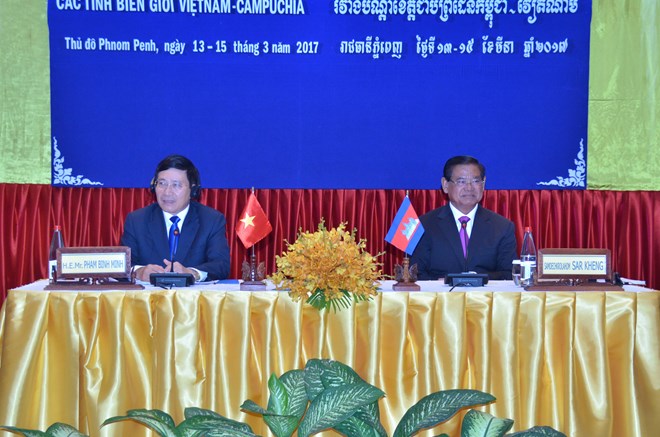
Vietnam’s Deputy Prime Minister and Foreign Minister Pham Binh Minh (L) and Cambodia’s Deputy Prime Minister and Minister of Home Affairs Samdech Sar Kheng co-chair the conference

VN, Cambodia border localities urged to do more for border of peace
Active coordination and the maintenance of regular and irregular meetings have allowed border localities of Vietnam and Cambodia to deploy reached agreements efficiently, helping maintain security and stability in the shared border.
Vietnam Net Bridge | 15 March 2017

It was remarked at the ninth Conference on Cooperation and Development of Vietnamese and Cambodian border provinces co-chaired by Vietnam’s Deputy Prime Minister and Foreign Minister Pham Binh Minh and Cambodia’s Deputy Prime Minister and Minister of Home Affairs Samdech Sar Kheng in Phnom Penh, Cambodia on March 15.
Since the eighth meeting in October 2015, the friendship and all-faceted cooperation between the two countries have continuously developed, the two sides noted.
Local officials paid regular visits while localities have assisted each other in building roads, training human resources, exchanging high-yield plants, providing healthcare services, and conducting cultural and sports activities.
Such activities enabled both sides to address arising issues and enhance their friendship, solidarity, cooperation and mutual assistance, the participants said.
They agreed to further boost the links between ministries, sectors, and localities, continue implementing reached agreements actively, fine-tune mechanisms and policies encouraging cross-border trade, and make it easier for respective investments.
The localities will work together in agriculture, forestry and fishery, healthcare, and human resources training, and pay heed to upgrading transport infrastructure and border trade areas.
They said they will speed up the land border demarcation and the planting of border markers while pledging to not allow any hostile force to use the one’s territory to sabotage security and stability in the other.
The localities agreed to reinforce cooperation to protect security, keep stability and order along the shared border while timely deterring and combating transnational crimes.
More people-to-people exchanges will be organized, as will education for border people, especially the youth, so to help them to understand the importance of preserving and fostering the traditional friendship, solidarity and mutual assistance for the respective interests.
Deputy PMs Pham Binh Minh and Samdech Sar Kheng asked ministries, sectors and border localities of the two countries to work more closely in carrying out devised measures to improve the efficiency of their cooperation, continue maintain political security and social order, improve locals’ living standards, and building the borderline of peace, friendship, cooperation and development.
During the conference, ministries, sectors and border localities had separate meetings to seek specific cooperative measures.
The two sides issued a joint statement at the end of the conference.
VNA

Wednesday, November 23, 2016

[Vietnamization:Border] Cambodian Opposition Leader Offers Border Policy Ahead of Next Election

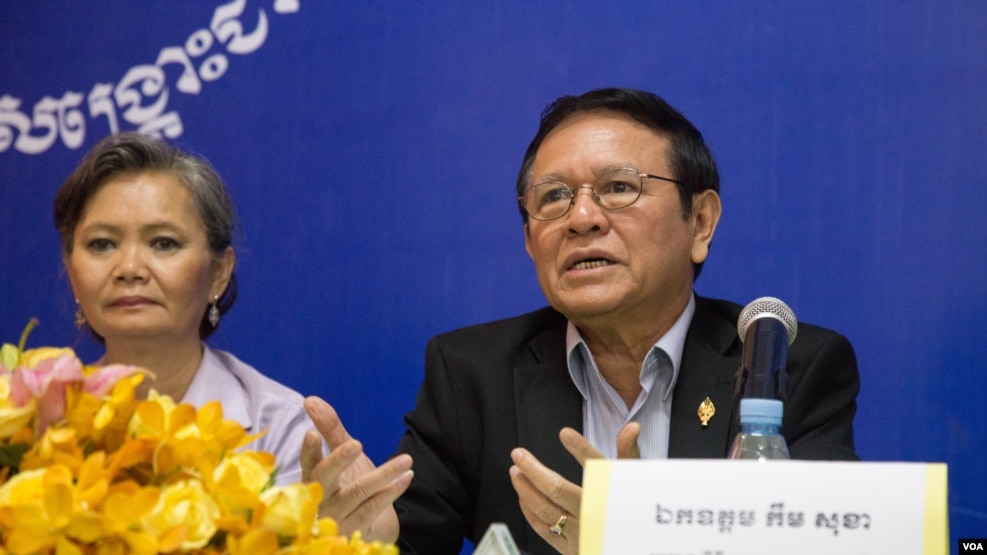
FILE - Kem Sokha, opposition CNRP vice president speaks to some CNRP's women commune councilors at CNRP's headquarter in Phnom Penh on Wednesday, August 10, 2016. ( Leng Len/VOA Khmer)

Cambodian Opposition Leader Offers Border Policy Ahead of Next Election

VOA | 23 November 2016

Immigration and border security would be priorities for a CNRP administration, he added, because of what he described as “invasions” of Cambodian territory by illegal immigrants and foreign interests.

Cambodia’s acting leader of the opposition has said that if the party is voted into power in 2018 he would institute a transmigration policy that would offer incentives to Cambodians who move to live near the border with Vietnam.

Wednesday, October 26, 2016

[Vietnamization] Border Land to be Exchanged

The delegation from Vietnam at a meeting in Phnom Penh in August. KT/Mai Vireak

Border Land to be Exchanged

Khmer Times | 25 October 2016

Delegates from both sides of the border at a meeting last week. Supplied
Cambodia and Vietnam have signed a memorandum of understanding (MoU) to exchange parcels of land in provinces along the border in both countries after Joint Border Committee meetings in Ho Chi Minh City in July and last Thursday.
 
The Vietnamese Foreign Ministry released information on its website last Thursday, initially in Vietnamese only, detailing the agreements ironed out in the meetings, focusing specifically on the exchange of land between both countries.
 
Both Le Hoai Trung, the deputy minister of Foreign Affairs for Vietnam, and Va Kim Hong, chairman of the border committee for Cambodia, signed off on the agreement along with various ministers from both countries.
 
Cambodian border committee officials attempted to downplay the news, saying the two sides had yet to actually discuss which plots of land would be transferred to Vietnamese control and vice versa. They only decided to allow a “group of experts” to study the situation and follow up with them.
 
Mr. Kim Hong did not respond to requests for comment yesterday, but told local media outlets that Cambodia and Vietnam have yet to transfer any land between each other.
 
“We have nothing to exchange. We just talked about the exchange in principle, because we have had this principle for a long time since the MoU in 2011, which Prime Minister Hun Sen said at the National Assembly,” he said.
 
“So nothing is new, it’s just a problem that we need to fix by exchanging some land in the provinces that we’ve seen, but we have not exchanged it because we have not agreed with each other yet.”
 
He said an exchange of land along the border would only be possible if the Vietnamese government “complied” with the terms and conditions of the agreement and held a neutral study first.
 
This is far from the first time Cambodia and Vietnam have either exchanged land or discussed the topic. In 2012, Cambodia negotiated with Vietnam to keep Thlok Trach village and Anlong Chrey village, the hometown of ruling party stalwart Heng Samrin, in exchange for two unnamed villages that are now Vietnamese.
 
The Cambodia National Rescue Party (CNRP) pounced on the issue and harshly criticized the government for using Cambodia’s territorial integrity as a trading chip.
 

Monday, December 28, 2015

[Vietnamization] Cambodia, Vietnam Celebrate New Border Posts

Cambodia, Vietnam Celebrate New Border Posts

The Cambodia Daily | 28 December 2015
Nearing the end of a year that has seen tension over Cambodia’s border with Vietnam often dominate domestic political discourse, Prime Minister Hun Sen on Saturday appeared alongside Vietnamese Prime Minister Nguyen Tan Dung to inaugurate two new border posts in Ratanakkiri and Takeo provinces.
Delivering a scripted speech at the unveiling of a new demarcation post near the O’Yadaw border checkpoint in Ratanakkiri, Mr. Hun Sen said the two countries would begin negotiations to demarcate their borders at sea once they have completed the remaining 1,270 km of land boundaries.
Prime Minister Hun Sen, right, and his Vietnamese counterpart, Nguyen Tan Dung, inaugurate a new border demarcation post in Ratanakkiri province on Saturday. (Reuters)
Opposition politicians launched a crusade earlier this year to highlight encroachments by Vietnam —including along the border in Ratanakkiri—and to discredit the government’s work demarcating its eastern frontier.

Thursday, October 29, 2015

[Vietnamization] Vietnam, Cambodia advance border province cooperation


Deputy Prime Minister and Minister of Foreign Affairs Pham Binh Minh (R) and his Cambodian counterpart Sar Kheng exchange a souvenir gift before the meeting on October 28, 2015.  Photo: Thanh Vu/VNADeputy Prime Minister and Minister of Foreign Affairs Pham Binh Minh (R) and his Cambodian counterpart Sar Kheng exchange a souvenir gift before the meeting on October 28, 2015. Photo: Thanh Vu/VNA

Vietnam, Cambodia advance border province cooperation

VNA / Thanh Nien News | 28 October 2015
They agreed to hasten land border demarcation and marker planting and pledged not to allow hostile forces use their respective territories to sabotage the other nation’s security and stability. Meanwhile, the two countries will strengthen collaboration and prevent transnational crimes along their shared border.
Vietnam and Cambodia Wednesday agreed on directions and measures to bolster cooperation between their border provinces and effectively settle arising and complex issues, the Vietnam News Agency reported.
The eighth meeting on border province cooperation and development, held in Ho Chi Minh City October 27-28, was co-chaired by Vietnam’s Deputy Prime Minister and Foreign Minister Pham Binh Minh and Cambodia’s Deputy Prime Minister and Minister of the Interior Sar Kheng.
The participants also included Vietnamese Ambassador to Cambodia Thach Du, Cambodian Ambassador to Vietnam Hul Phany, and representatives of 10 Vietnamese border provinces and nine conjoining localities of Cambodia.

The two Deputy PMs reviewed progress in the countries’ relations since the previous meeting in March 2012, saying the solidification of Vietnam-Cambodia’s traditional amity and comprehensive cooperation had contributed to peace, stability, cooperation and development in areas along the shared border.
The two sides have maintained regular delegation exchanges at all levels and cooperation mechanisms, they said, highlighting the success of the 14th meeting of the countries’ joint committee on economic, cultural and scientific-technological cooperation in Ho Chi Minh City on October 18-19.
Data shows that bilateral trade between Vietnam and Cambodia reached US$2.3 billion in the first eight months of 2015, up 4 percent from a year earlier.
Vietnam is currently the second biggest investor in Cambodia with 172 projects worth $3.61 billion.