

Cambodia: child protection workers call for end to ‘orphanage tourism’
Volunteers and visitors urged to stay away, saying their growing presence damages children and allows exploitation
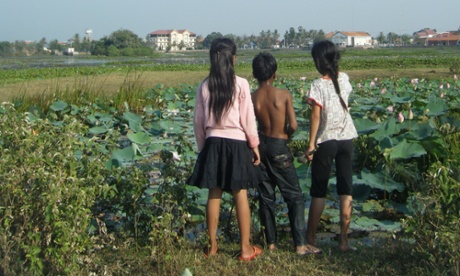
Child protection and NGO workers are pleading with tourists and
volunteers to stay away from orphanages in Cambodia, claiming so-called
“orphanage tourism” damages the children and enables exploitation.
The number of Australians visiting Cambodia is increasing, as are the number of orphanages in the country, rising by 75% in the five years to 2011, according to UNICEF.
However, most children living in them (about 77%) are not orphans and
child protection workers say such institutions should be an absolute
last resort.
The NGO helps marginalised children and youth
and their families. Occasionally it takes children into its care
temporarily, but Gracie said it was much more important to provide
support and enable the child to stay with family if appropriate.
“Long-term residential care really should be the absolute last resort. It should be a fraction of your response,” he said.
In 2010 there were 269 residential care homes in Cambodia housing
11,945 children. In the five years before that about 44% of children
entering institutions were taken there by their parents or other family
members, government data showed.
The Cambodian government has introduced policies to impose minimum
standards for child protection, but Gracie said it was struggling with
implementation. There are still rogue institutions and a lack of
enforcement around registration. Numerous institutions, including some
with Australian links, have been accused of exploitation and abuse.
“It is quite simple in Cambodia for people, especially foreigners, to
come in and set up an organisation, set up an orphanage, and either
have it registered or not,” he said.
Visits from tourists and volunteers – known commonly as “orphanage
tourism” – lend credibility to institutions and the numbers are
increasing.
“It’s a big business in Cambodia,” said Gracie. Friends International frequently campaigns against the practice.
“There are no kinds of checks on these people, they could be
predators, they could be anyone,” he said, and it’s putting the kids at
risk as well as creating attachment disorders.
“People are coming in, attaching to [the children] and then leaving.
It’s highly damaging for the emotional and cognitive development of the
kids.
“It’s a dangerous situation, because particularly bad [orphanages]
will keep the children and the orphanage looking just pathetic enough in
order to illicit sympathy and get donations,” he said.
That money often does not go to the children, child welfare workers told Guardian Australia.
Eve Saosarin, from Sihanoukville family outreach centre M’Lop Tapang,
said it also avoided letting tourists visit or spend time with the
children in their temporary care.
“We get a lot of emails from tourists that want to visit our centre
but usually we refuse because our centre is for the safety of our
children,” Saosarin said.
Orphanage tourism is a problem for the beachside region. “We have
some very good tourists but we also have some bad tourists who come to
look for the children,” said Saosarin, adding that greater co-ordination
between local people, authorities and tourists was needed to improve
child protection and education.
“The children are increasing because people are coming to
Sihanoukville in search of a better life but because they have no
experience they end up in the slums and … send their children to the
streets,” she said.
These children often end up in the care of M’Lop Tapang or in one of the many orphanages.
Other children arrive in the institutions in the hope of receiving a
better education than would be possible from the under-resourced
national system, Unicef’s Rana Flowers told Guardian Australia.
“The families want the kids to have an education but the costs and
the hidden costs of sending them to a school in their community is
around 25% of what they earn a month,” she told Guardian Australia from
Phnom Penh.
“But when you look at the standards within the institutions, in the
majority of them the children are neither being fed well nor are they
reaching grade-level education.”
Flowers said the education and social welfare systems needed improvement.
“The focus that we’re trying to build is very much on working with
the government to build a system-wide approach, where we have a
continuum of care for children from the time they are born through to
the time they are 18,” Flowers said.
“Our goal has to be to close as many as possible of these centres in
the coming period. We’re going to have to do it in a phased manner and
find places for the children and make sure they have safe communities
that they can return to, but there should be no more centres.”
Flowers called for an end to volunteer placements at orphanages,
instead directing foreigners to community and education projects.
“The really important message for all the tourists coming from
Europe, from Australia, from the US, is that you are driving an industry
that is incredibly abusive and exploitative of children.”
Friends International’s Gracie said visitors needed educating about child protection.
“People mean well, 99% of people feel they are doing something right
and helping the children, providing them some fun… but our argument is
that we suggest people think twice about it and think of the longer-term
harm that they could be causing.”

No comments:
Post a Comment