

Cambodia Foreign Minister Previews Upcoming UN Speech
VOA | 29 September 2014
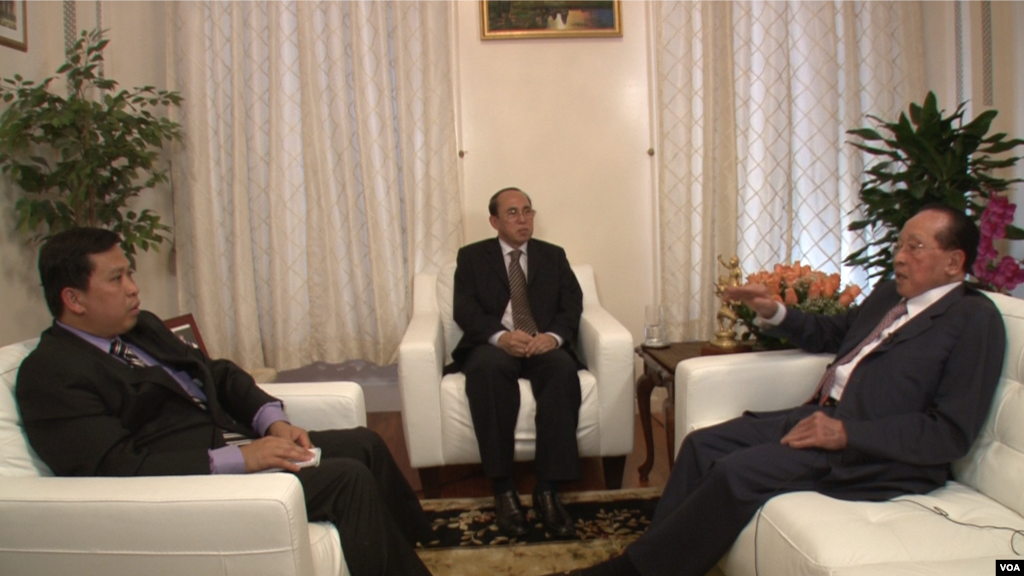
NEW YORK—Cambodian Foreign Minister
Hor Namhong is slated to deliver a speech to the UN’s General Assembly
on Monday in New York. His speech comes as Cambodia’s profile on the
world stage has expanded in recent years.
Cambodia has an improved economy and a growing relationship with
China and is moving toward the completion of a UN-backed trial for two
aging Khmer Rouge leaders. But Hor Namhong’s speech also comes amid deep
criticism of Cambodia’s human rights record and a controversial
agreement with Australia to help it resettle refugees in exchange for
aid money.
Hor Namhong spoke to VOA Khmer in New York on Saturday, as he prepared for his Monday delivery.
“Neither Australia nor Cambodia will force any individual to come to Cambodia,” he said.
The agreement was discussed with the UN High Commissioner for
Refugees beforehand, he said, and Cambodian leaders believe they
understand the needs of refugees, given the country’s past. Responding
to criticism of Cambodia’s human rights record and its inability to aid
refugees, Hor Namhong said, “Development in Cambodia has improved
strongly, which allows us to take them.”
Cambodia allows “thousands” of NGOs to operate in the country, he
said, and allows a UN human rights office. Cambodia has regular visits
from a special UN rights envoy, he said. Cambodia must still prepare a
“practical foundation” for the refugees’ resettlement, he said, which
will include finding “volunteer immigrants” willing to come to Cambodia,
from where they are being held on the Micronesian island of Nauru. It
is not known how many will resettle, he said, but Cambodia has not put a
limit on how many it will take.
“It depends on their decision,” he said. “And second, it depends on the place where we need to host them properly.”
Cambodia will receive $40 million in funding from Australia for
general development, but Australia has also pledged funding for the
resettlement itself, he said. “Because we’ll take the refugees someplace
where they will stay until they can find jobs,” he said.
Meanwhile, the resettlement question is not the only international
issue facing Cambodia. Islamic extremism, the South China Sea and other
issues exist for Cambodia to consider.
Hor Namhong said Cambodia has not changed its stance on the Islamic
State and supports counter-terrorism. “We have always opposed
terrorism,” he said. He called the public killings of Westerners by
extremists “absolutely atrocious.”
Prime Minister Hun Sen remains the head of Cambodia’s Anti-Terrorism
Authority. “That means Cambodia is strongly paying attention to [the
issue of] terrorism,” Hor Namhong said. Cambodia supports to
international effort against the Islamic State, but will not send
troops, he said. “Cambodia will support this through other means.”
On the issue of conflict in Ukraine, Hor Namhong said he regretted
the violence there. Cambodia is concerned about a new Cold War between
the West and Russia if economic sanctions continue, he said.
For the Khmer Rouge Tribunal, Hor Namhong said the trials had been
“delayed too much.” The two remaining defendants, Nuon Chea and Khieu
Samphan, are getting older and have health problems. “So what I’ve been
concerned about so far is that the court has spent hundreds of millions
of dollars, but does not have any more defendants to try,” he said.
Cambodia, meanwhile, spends about $1.8 million per year on the court’s
operations and remains willing to see it continue, he said.
On the South China Sea, which sees overlapping claims from Cambodia’s
Southeast Asian neighbors and China, one of its biggest economic
supporters, Hor Namhong said Cambodia’s position was that the disputes
are “bilateral.” Cambodia supports a declaration of conduct that would
prevent open conflict, he said. Asean and China, meanwhile, have made
“steps toward a peaceful solution on the matter,” he said.
On climate change, Hor Namhong said that developed countries—“I don’t
want to mention the names”—should reduce their greenhouse emissions.
“The biggest developing countries also produce a lot of greenhouse
gases,” he said.
Commenting on a recent speech by US President Barack Obama, in which
he praised two Cambodian rights activists, Hor Namhong said Cambodia
continues to improve its human rights record. Obama mentioned
specifically the murder of forestry activist Chut Wutty, in 2012. Hor
Namhong said that case “is not completely closed.”
Finally, Hor Namhong said Cambodia continues to enjoy peace and
prosperity. A deal earlier this year between the ruling party and the
opposition means “political stability” and “reform,” he said. “Hun Sen
pledges to make deeper reforms for the better in the economy, democracy
and human rights,” he said. “So we should enjoy our peace, our political
stability, our economic growth and our poverty reduction.”

No comments:
Post a Comment