

China intensifies lobbying of other nations ahead of South China Sea court ruling
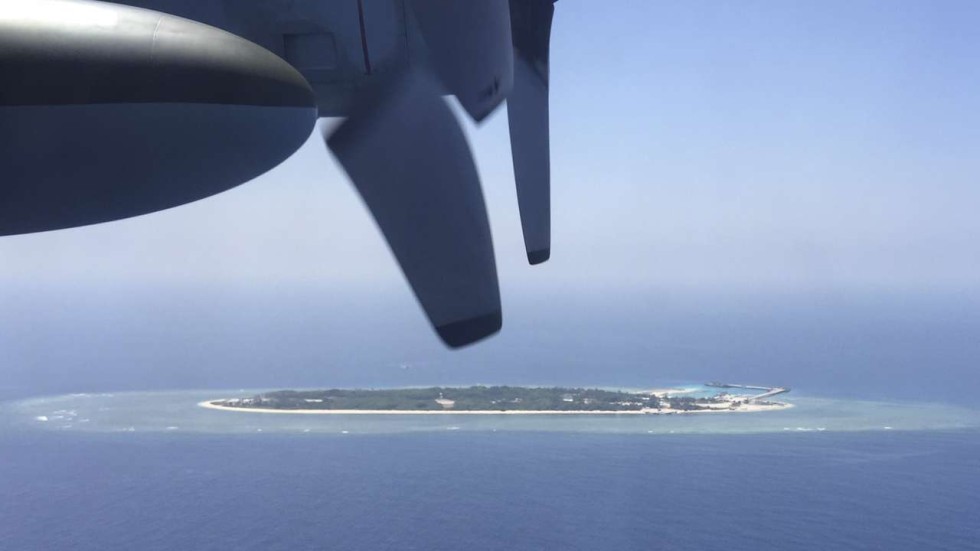
China is intensifying its global diplomatic
campaign to win support ahead of an imminent international court ruling
over the South China Sea disputes.
The development came yesterday as Beijing vowed
greater cooperation and to proceed with multinational military
exercises with Southeast Asian nations, but also called on countries to
back its stance on the territorial disputes – putting many in a dilemma
as they have to side with either China or the United States.
China to build up atoll in contested South China Sea, source says
President Xi Jinping told a group of foreign
ministers from Asia and the Middle East that the disputes should be
resolved through negotiations between the countries involved. “We insist
we should peacefully resolve the disputes through friendly
consultations and negotiations with other parties directly involved,” Xi
said.
Beijing also said it had reached a consensus
with Belarus and Pakistan – which are not claimant states – that said
they respected China’s stance on the issue, after separate meetings
yesterday with the two nations’ foreign ministers on the sidelines of
the Conference on Interaction and Confidence Building Measures in Asia.
The State Oceanic Administration said Beijing
was working on a five-year cooperation plan in the disputed waters
between China and the Association of Southeast Asian Nations, Xinhua
reported.
The defence ministry said China would send
missile destroyer Lanzhou and special forces for a maritime security
and anti-terror exercise next month with the bloc in waters between
Singapore and Brunei.
Beijing is also keen to approach nations in
Europe and Africa to consolidate its diplomatic base ahead of the ruling
by the Permanent Court of Arbitration at The Hague, in a case launched
by the Philippines. China says the court has no jurisdiction in the
matter.
Taiwan, Vietnam, Malaysia and Brunei also lay claim to the waters in the South China Sea.
Beijing says it has agreed with Cambodia, Laos
and Brunei that the disputes would not affect Sino-Asean ties. But
Cambodian government spokesman Phay Siphan said his country had reached
no new agreement with China over the dispute, the Phnom Penh Post reported.
But the diplomatic move has sparked concern over
whether Beijing is taking the dispute to the international stage – in
contrast to its stance that the matter is a bilateral issue – and may
backfire.
China unlikely to come to North Korea’s defence if tensions escalate over nuclear weapons tests, say Chinese experts
“Countries in the region want to be able to
cooperate with China and have good relations with Beijing; they don’t
want to face coercion or intimidation on matters of security or economic
policy. Claimants would much prefer a peaceful resolution of disputes,”
Paul Haenle, director of the Carnegie-Tsinghua Centre, said.
But Zhu Feng, executive director of Nanjing
University’s China Centre for Collaborative Studies of the South China
Sea, said Beijing had “no choice” as the US was also doing the same,
referring to an earlier statement made by G7 foreign ministers that
expressed opposition to “provocative unilateral actions” in disputed
waters.
Manoranjan Mohanty, former chairman of the
Institute of Chinese Studies in Delhi, said nations were feeling the
pressure from both China and the US. The US was also pressuring Asean
members over the disputes.

No comments:
Post a Comment