

Background:
The Vietnamization of Kampuchea: A New Model of Colonialism (Indochina Report, October 1984)
Part
II: Vietnamization of the Economic Framework (continued)
The
Unequal Exchange
It
is within this new institutional framework that the Vietnamese are asserting their hold over the economy
and future of
Kampuchea. Fisheries, rubber and rice are the three main sectors affected by what should be termed the Unequal
Exchange between Vietnam and Kampuchea.
As for fisheries, a cooperation accord was signed on 20 January 1984 between Phnom Penh's Ministry of Agriculture and Hanoi's Ministry of Marines Products.
As for fisheries, a cooperation accord was signed on 20 January 1984 between Phnom Penh's Ministry of Agriculture and Hanoi's Ministry of Marines Products.
During
his visit to Phnom Penh, the Vietnamese Minister Nguyen Tien Trinh has
pledged to provide "all kinds of assistance to
the PRK's Ministry of Agriculture, including fishing tools and moral, maternal
and technical aid for building fishing sites
and shrimp boats for sea fishing, in order to develop the
Kampuchea-Vietnam solidarity in fisheries." On this
occasion, Khmer Minister of Planning Chea Soth curiously expressed the
confidence that "with the assistance of the
Vietnamese delegation, Kampuchea's fisheries will soon make progress!"
In
reality, what is this accord about? Behind all the redundant jargon, the agreement serves only to sanction the near monopoly of the
Vietnamese over the fisheries resources in Kampuchea, and in
particular in the Sea-Lake area (Tonle Sap).
. . .
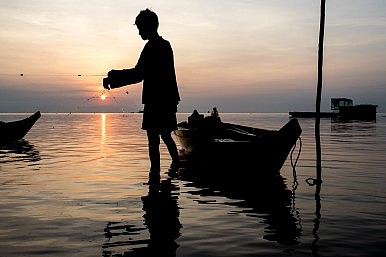 |
A boy untangles his family fishing net in the village of Akol.
Image Credit: Luc Forsyth
|
The Tonle Sap: Cambodia’s Beating Heart
Luc Forsyth and Gareth Bright have set out on a journey to follow the Mekong river from sea to source. The Diplomat will be sharing some of the stories they’ve found along the way. For more about the project, check out the whole series here.
Following the Tonle Sap river further inland to the massive lake of
the same name, we spent several days on a floating research station as
we explored the area’s floating villages, interviewed fishermen, and
learned about the great challenges facing the Tonle Sap.
* * *

The
Tonle Sap is known to be one of the world’s most productive freshwater
ecosystems, but all is not well. Photo by Gareth Bright
The fisherman spoke in a muted voice that barely carried over the few
meters between our boats. The night was moonless and it was pitch black
at 3:30 am on the Tonle Sap lake. We needed to use our headlamps to
check the focus of our cameras and were at first confused by the
fisherman’s apprehension. When we asked if he was worried the LED beams
would scare the fish away, he replied calmly: “No, it’s because we are
in the conservation zone. If they catch us we will be in trouble.”

A boy runs along the gunnels of a fibre glass fishing boat in the village of Akol. Photo by Luc Forsyth
Two hours later, in the shallow water surrounding the floating
village of Akol, the fishing boats gathered in the blue pre-dawn light
to check their catch. Their mood was cheerful as they picked through the
nets, pulling healthy (if smallish) looking fish from the nylon mesh
and tossing them into large metal bowls. There was no sign of their
former nervousness, the danger apparently passed.
Considering that the lake was known to be one of the world’s most
productive freshwater ecosystems, as well as one of the main sources of
protein for the country’s 15 million people, the fact that fishermen
were resorting to sneaking into protected areas spoke of an alarming
truth: the Tonle Sap, often referred to as “Cambodia’s beating heart,”
was struggling.

Fishermen pick through their nets near the village of Akol. Photo by Gareth Bright
“Outside the conservation area there are no fish, so what should I
do?” Chan Savoeun asked us rhetorically. A 28-year-old fisherman (whose
name has been changed to protect his identity), Savoeun had been fishing
in the Tonle Sap for more than a decade, and was well aware of the
lake’s ailing health. “I am catching around 30-50 percent less fish than
I did [10 years ago], so we have no choice but to fish in the protected
zone. We know this is not good, and we are all worried about what will
happen if there are no fish left [in the conservation area], but how
else can we survive?”

Fishermen pick through their nets near the village of Akol. Photo by Luc Forsyth
The Great Lake
We had come to Akol, a floating community of roughly 30 families, to
try and learn how the Tonle Sap (commonly translated as “The Great
Lake”) influenced those who lived from its floods. Though it was the
peak of the dry season and the village’s pontoon houses were tethered to
an exposed sandbar, their temporary attachment to land did not lessen
their dependence on the water. “There is not one family here who does
not earn their income from the lake,” Savoeun told us.

During the dry season, Akol’s pontoon houses are tethered to an exposed sandbar. Photo by Gareth Bright
Looking around, it was easy to see the truth of what Savoeun said.
Apart from a makeshift volleyball court erected on the coarse red sand
and a few wells (which, full of lake water as they were, were meant for
convenient showering and dishwashing rather than as a source of clean
potable water), it was apparent that very few, if any, aspects of life
in Akol were dictated by access to dry land. There was only one
permanent structure, still under construction, and it was destined to
serve as an office for an international conservation organization. When
the monsoon rains returned later in the year and the lake’s level rose
by up to 8 additional meters, the village could lift anchor and drift
away, leaving the office to stand alone.

The
village’s only permanent structure, still under construction, is
destined to serve as an office for an international conservation
organization. Photo by Luc Forsyth
But the Tonle Sap, whose once bountiful waters support dozens of
communities like Akol, was not well. Generations of overfishing,
combined with a rapidly growing population, had stretched the lake’s
already diminishing fish population to its breaking point, as evidenced
by the morning’s trip into the protected zone. The widespread use of
illegal fishing equipment — from nets so fine that even the smallest and
youngest fish were trapped to battery-powered electric nets that killed
every living creature in the shock radius — had further decimated
stocks. Deforestation and human-induced bush fires had ravaged the
aquatic trees amongst whose submerged root systems young fish were
hatched before migrating into deeper waters.

The village of Akol floats on the Tonle Sap. Photo by Gareth Bright
“I noticed that animals were being reduced by hunting and fishing,
and that the forests were burning — so I asked for this job,” Horm Sok, a
field researcher employed by Conservation International told us.
Though he had only held the job for six years, Horm Sok had been
living in Akol since 1979 and has borne witness to the dramatic changes
afflicting the Tonle Sap. “The population has grown so much and the fish
are disappearing,” he told us as we followed him through the sweltering
jungle to see some of the conservation initiatives he oversaw. “There
didn’t used to be so many fishermen or illegal fishing.”

Horm
Sok, a researcher for Conservation International, drags a boat over a
shallow sandbar on his way to an area of forest he is responsible for
monitoring. Photo by Luc Forsyth.
Horm’s responsibilities ranged from monitoring forest fires to
photographing otter dung as a means of monitoring species numbers, but
there were two projects in particular he hoped would be effective in
slowing the loss of marine life.
Destruction of the coastal forests that acted as nurseries for infant
fish was caused by multiple factors, he told us, almost all of which
involved human activity or negligence. Carelessly tended cooking fires
had sparked blazes that ravaged 30 hectares of land in the last year
alone. “The loss of 30 hectares represents up to 3 percent of the future
fish population,” Horm said, adding perspective. And while the loss of
20 football fields worth of forest might not seem like a dramatic number
on a global scale, in a country with the third highest rate of
deforestation in the world, Cambodia was a place with few trees to
spare.

Horm
supervises the protection of several fish nurseries in small ponds what
will be absorbed into the lake when the dry season is over. Photo by
Gareth Bright
Additionally, Horm supervised the protection of several fish
nurseries that played an even larger role in repopulating the Tonle
Sap’s fish. “There are thousands of fish in each pond,” he told us,
gesturing to a muddy pool 4 km inland from the lake, protected from
exploitation only by the permanent presence of a paid security guard. So
far from the water it was difficult to see a connection between the
stagnant ponds and the Great Lake, but when the water level rose in
several months the entire area would be inundated, absorbing the young
fish into its vastness. “Ponds like these can contribute up to 20
percent of all fish [in the lake],” Horm told us, contextualizing what
we were looking at.

A fisherman picks fish from his net. Photo by Luc Forsyth
“It’s not about the money,” Horm said when we asked about his
motivations for undertaking such a monumentally difficult task as
keeping the Tonle Sap healthy. “I asked for this job because I want to
conserve the animals and the forest. When I see the fish [vanishing] and
the forests burning I feel a lot of regret.”

Horm has been living in Akol since 1979, six years ago he took a job to preserve the lake. Photo by Gareth Bright.
A Lake Like No Other
“There is nothing else like the Tonle Sap. It’s like an inland ocean,
a fish soup,” Taber Hand, founder of the water-focused social
enterprise group Wetlands Work!, told us in his Phnom Penh apartment.
Though we were physically distant from the lake, his passion for its
health was plain and his knowledge vast.

A boy checks his nets. Photo by Luc Forsyth
“There are more fish by tonnage in the Tonle Sap than in both the
commercial and recreational freshwater sectors of the United States and
Canada combined,” he continued, surprising us with the staggering
statistic. “But the lake is a poster child for tragedy.”
Paradoxically, one of the most devastating environmental blows to
Cambodia’s waterways was the government-mandated closing of industrial
fishing corporations in the early 2000s. In an attempt to garner
political support, the incumbent government ordered that all large scale
commercial operations be disbanded and the fishing grounds returned to
the people. While the idea might seem harmless on paper, the real world
results were devastating. Despite the huge numbers of fish caught by
industrial fishing, the international corporations involved understood
that they needed to protect the ecosystem in order to secure a financial
future for their companies. When these companies withdrew, taking with
them the armed guards who protected their fisheries, a resource
free-for-all ensued. In the mad dash to claim land for rice farming,
harvest valuable tree species, and fish the abundant waters, the
populist policy brought about widespread destruction.

Early morning on the Tonle Sap. Photo by Gareth Bright
“The industrial fisheries protected the lots by force, which angered
the population. But by playing to the people, [Prime Minister Hun Sen]
doomed the waterscape. The former lots have become habitat wastelands,
totally destroyed by deforestation. They’re probably getting 0.5 percent
of what those areas produced before,” Hand explained.
Additional factors such as government corruption (bribed fisheries
officials selectively ignoring illegal fishing practices), agricultural
pollution, and population growth, have further exacerbated the problem.

A shrimp fisherman checks his nets. Photo by Luc Forsyth
Though he emphatically told us that there are variety of actions that
could be undertaken to restore the Tonle Sap, Hand was pragmatic when
we spoke about the likelihood of these steps being taken in time.
“The biodiversity is there to provide more than enough,” Hand told
us, “but it’s the human side of the equation, the human priorities, that
don’t fit. We could have our cake and eat it too, [the solution] is
right there for us to act on, but people want to work for themselves
instead of together.”

Cambodia’s Great Lake provides much of the country’s protein. Photo by Gareth Bright
In an impoverished country like Cambodia where millions battle on a
daily basis to feed their families, it is perhaps not surprising that
environmental cooperation is not a top priority. But without such a mass
movement, Cambodia’s most important waterway was headed for disaster.
As our meeting with drew to a close, Hand reflected on a telling
fact: “‘The Tonle Sap is the heart and soul of Cambodia’ used to be an
extremely popular saying. Everyone said it, including the prime
minister. But you know, I don’t think I’ve heard anyone say that in at
least 10 years.”

Children play near the village of Akol. Photo by Luc Forsyth

No comments:
Post a Comment