

 |
| Judge Asean by what it has prevented, rather than achieved, some say |
What's the point of Asean?
BBC News | 25 July 2016
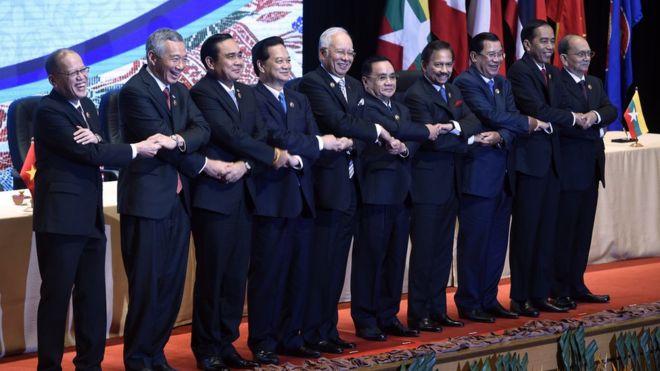
Fourteen years after they first began discussing their differences with China over the South China Sea, the 10 members of Asean - the Association of Southeast Asian Nations - have once again bowed to pressure and produced a watered-down joint statement at their summit, in Laos.
No mention of China, which has been creating "facts" in the sea by building islands on disputed reefs.
No mention of the recent ruling at the Permanent Court of Arbitration in The Hague that China had no historic rights over the area.
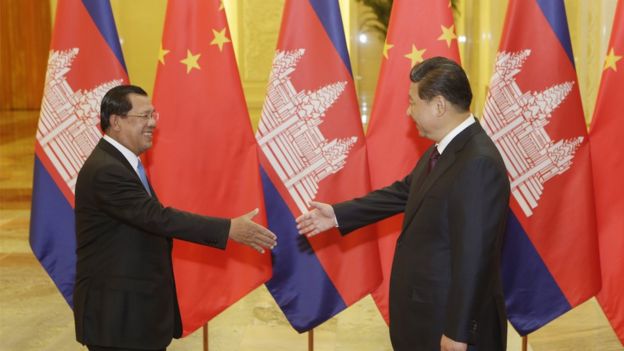
Once again, it was the smaller Asean members under China's thumb - Cambodia, and host-nation Laos - that were the weak link in the bloc's efforts to stand up to its giant neighbour.
And so, once again, the question pops up: what is the point of an Asean so crippled by its consensus-based decision-making that it rarely makes any decisions at all?
 GETTY IMAGES
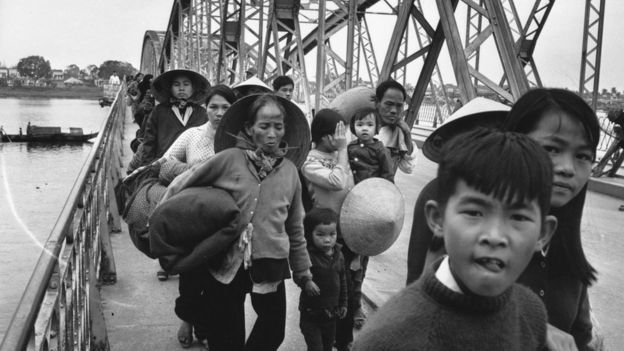
Many years ago I put this question to Singapore's then-trade minister George Yeo. He suggested I look not so much at what Asean had achieved, as what it had prevented. An impoverished, war-torn region caught up in the hottest of Cold War conflicts was, he said, turned into a zone of peace and prosperity.
By diffusing disputes through the "Asean Way" of meetings, seeking consensus and forswearing any interference in one another's internal affairs, the economies of South East Asia were able to tap into the global supply chain and start their impressive growth.
 GETTY IMAGES
What is Asean?
- Founded in 1967 by Thailand, Malaysia, Singapore, Indonesia and the Philippines
- Later expanded to include Brunei, Vietnam, Cambodia, Laos and Myanmar
- Purpose is to promote co-operation and collaboration between member states, peace and stability, economic integration and growth, and an "Asean Community"
- Works on principles of consultation and consensus, non-interference, non-confrontation and the peaceful settlement of disputes
- Asean Secretariat is based in Jakarta, Indonesia
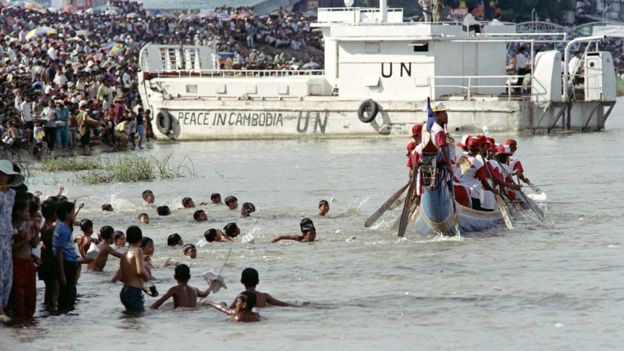
Asean's proudest achievements are its role in ending the Cambodian civil war and bringing the three Indochinese countries into its fold in the 1990s, and its patience, in the face of Western criticism, with Myanmar's military leaders as they shuffled in the direction of democratic reform.
But the association's weaknesses have been cruelly exposed by China. There is no mechanism to ensure solidarity in Asean, just a seemingly endless series of meetings - more than 1,000 every year - in which backroom diplomacy can undo a hard-won consensus decision in minutes.
 AFP
AFP AFP
AFP
The Asean secretariat, with just over 300 staff, is hopelessly under-resourced just to manage the logistics of these constant get-togethers.
There are no Asean institutions to rival the EU's Commission. Council of Ministers and Court of Justice. The so-called Asean Economic Community, launched with great fanfare in Malaysia last year, is little more than a set of distant aspirations.
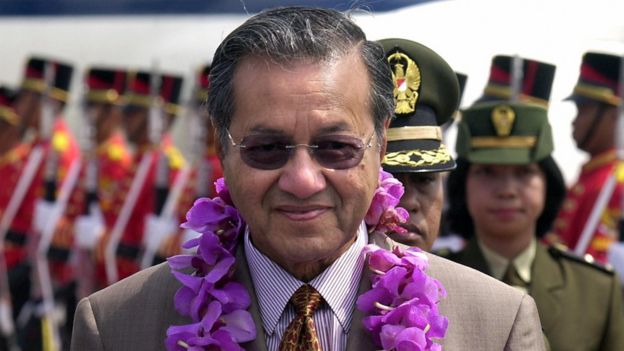
Asean also lacks leaders of the stature of its founding fathers to drive the bloc forward.
There is no-one now to match the charisma of Singapore's Lee Kuan Yew and Malaysia's Mahathir Mohamad.
Its supporters often cite Asean's usefulness as a forum that brings regional powers together, like the East Asia Summit, and the Asean Regional Forum which are attended by leaders and foreign ministers of countries as diverse as the US, Russia, India, China, Japan, Australia and North Korea.
 AFP
AFP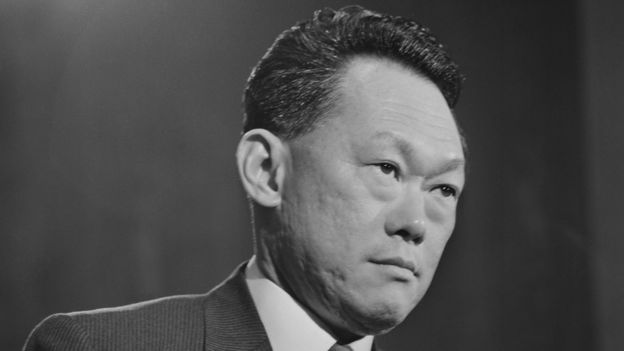 MICHAEL STROUD/HULTON ARCHIVE
It is true there is nothing else quite like these gatherings and, although they invariably produce bland and non-committal joint statements, they do offer unique opportunities for otherwise impossible bilateral meetings.
I recall the excitement in Brunei in 2002 when, in the aftermath of President George W Bush's "Axis of Evil" speech, we heard that Secretary of State Colin Powell had met his North Korean counterpart over a cup of coffee. It turned out, though, that with the complications of translation, they never went much beyond some innocuous pleasantries.
But the truth of these big meetings is they end up eclipsing Asean itself. It's a bit like holding a party, inviting a group of super-celebrities, and then finding that the stars only talk among themselves.
In a region confronted by growing tension among the powers on its borders, and challenges like climate change, it is no longer enough for Asean to be the mere talking shop it has been content to be for so long.

One crazy guy can screw up the entire Asean. Revoke his membership and send him back to the stone age.
ReplyDeleteI'm glad we got one crazy guy to screw up Asean. It's the UN that is screwing up this whole world. I wish we could go back to stone age and avoid the tyrannical government of the UN. The future is bleak if the UN would have their way in this world--perhaps they will, but only for 3/12 years of Dictatorship and their power will be broken.
ReplyDeleteAh Kork Hun Sen is very stupid and dumb. He doesn't know anything about the world around him. He was just a Vietnamese puppet "in Khmer language, he has been called AH YONG YUON" and this guy "Ah Kork Hun Sen" has been secretly used and manipulated by his Vietnamese/Yuon masters in Hanoi in order for killing millions of Khmer/Cambodian again in the blind eyes of the International Community and UN. Yuon/Vietnamese masters in Hanoi are the dirty minded killers other than China when it comes Cambodian Killing Fields from 1975 to 1979. So, China has been accused to support Pol Pot during Khmer Rouges regime while the Vietnaemse/Yuon secret agents were hiding in Khmer Rouges uniforms {who spoke Khmer/Cambodian language very well} and killed innocent Khmer people in order to reduce Cambodian population. Yes, Cambodia is annexed by Vietnam while China is not close to Cambodia border. Vietnamese/Yuon master-minded killers in Hanoi have been so clever and planning very dirty wars and trick to fool the world. China and Khmer Rouges led by Pol Pot have been accused as the killers or the scapegoats.
ReplyDelete