

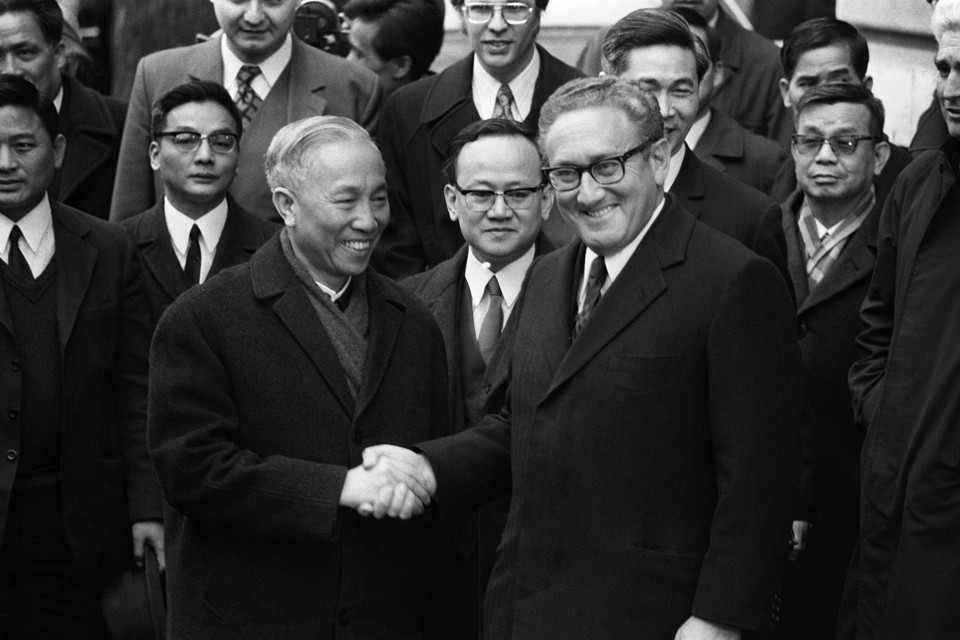
 |
| Henry Kissinger shakes hand with Le Duc Tho, leader of North Vietnam delegation, after the signing of the Paris Peace Accords on January 23, 1973 |
Kissinger: The View From Vietnam
One of the saddest ironies of my own history is that the United States might have achieved its goals in Southeast Asia without ever going to war.
One of the more telling moments of the political season occurred on February 11, in the middle of a Democratic primary debate between Bernie Sanders and Hillary Clinton. Surprisingly, it concerned Henry Kissinger. Clinton had made no secret of her amity for Kissinger—a fact Sanders found distasteful, to say the least. “I am proud to say that Henry Kissinger is not my friend. Count me in as somebody who will not be listening to Henry Kissinger,” Sanders said.
Sanders is intimately familiar with Kissinger’s long history of controversy. Among those controversies is his instrumental role in President Richard Nixon’s illegal bombing of Cambodia. From 1969 to 1973, the United States dropped 540,000 tons of bombs on the country, killing anywhere from 150,000 to 500,000 Cambodians. The intent, according to Nixon and Kissinger, then Nixon’s national security advisor and, for a time, also his secretary of state, was to interdict communist Vietnamese troop movements through Cambodia. For Sanders, this policy and others like it made Kissinger “one of the most destructive secretaries of state.” In response to Sanders, Clinton defended her sometimes-mentor. “It’s a big complicated world,” she said, offering Kissinger’s opening to China as an example of his diplomatic stewardship.
In that moment, Clinton lost my vote. Not only for her stance on Kissinger, but for how that stance aligned with her widely shared perspective on American exceptionalism. “America is great because America is good,” she said at the Democratic National Convention, summarizing a bipartisan consensus that is strong in Washington and across the country. As a refugee from Vietnam, a country the United States bombed, mined, and laced with Agent Orange for years, I have doubts about America’s core goodness.
I arrived in the United States as a refugee from Vietnam in 1975, fleeing the capture of the country by communist forces. As Americans reeled from their defeat, they assuaged their guilty consciences by taking in Vietnamese refugees. Rescuing these refugees affirmed the essential nobility of the American character. But, like my narrator in my novel The Sympathizer, I was “one of those unfortunate cases who could not help but wonder whether my need for American charity was due to my having first been the recipient of American aid.” The United States ostensibly conducted its bombing campaigns in Vietnam, Cambodia, and Laos, for the purposes of helping those countries, defending them in the name of freedom and democracy. But I get nervous whenever politicians and upright citizens use lofty, noble words like these. At their utterance, I can already hear the engines of the B-52s roaring to life.
One of the saddest ironies of my own history is that the United States might have achieved its goals in Southeast Asia without ever going to war. Capitalism has triumphed in today’s Vietnam, despite the enduring rule of the Communist Party. Why was it necessary to turn the former Indochina into a live theater of the Cold War, one that resulted in the deaths of millions of Southeast Asians? Here, I include the deaths of Cambodians under the Khmer Rouge who, some historians argue, rose to power because of the destabilizing consequences of the Kissinger-supported American carpet bombing of their country.
A realist might dismiss the utility of pondering an alternate history for Southeast Asia, one where negotiation, financial and infrastructural investment, human outreach, and efforts towards peaceful resolution and cooperation might have produced a different outcome. While we can’t change the past, imagining alternatives—something Clinton and her class seemed unwilling to do—is the only way to find a different way forward. Kissinger appears uninterested in such deliberate introspection, simply preferring to accept the brutal world as it is.
To understand Kissinger’s concession to brutality, consider the justification he offers for the bombing of Cambodia in the Goldberg interview. The campaign was undertaken, he says, to prevent North Vietnamese exploitation of that country. The fact that the North Vietnamese illegally violated Cambodian sovereignty is no justification for an illegal American bombing. What Kissinger’s perspective reveals is a belief that the rule of law is determined by the rule of power. The most powerful state—the one most capable of inflicting violence—dictates what is lawful.
The endorsement of Kissinger by Gerald Ford, Ronald Reagan, and, eventually, by Clinton, has normalized him, making his views a central part of American statecraft by casting him as a fount of establishment gospel—a gospel that preaches the value of American humanity and accepts as necessity the casual destruction of other people and places. Normalization of this sort, also perpetuated by figures in the media, policy experts, and academics, is dangerous. It transforms the deplorable into the acceptable. Donald Trump is now trying to make such a shift; there is no guarantee that he will fail. Kissinger offers a lesson in how to succeed, by never disavowing and never apologizing, and by relentlessly persuading others of the legitimacy of his diplomacy.
While I object to Kissinger’s decisions from a moral point of view, they are also dangerous strategically, especially when yoked to the “American is great, because it is good” narrative that is frequently espoused by Americans. They have a hard time comprehending why other people might resent being bombed, since, after all, it’s for their own good, to save them from whatever danger Washington believes also threatens their country. When Americans then suffer blowback, they cannot understand why anyone would respond to their good intentions with deadly attacks. And Kissinger’s view—that force must be met with even greater force—is legitimated, then perpetuated.
As an American and as a refugee, I see the world both from the aerial perspective of American drones and from the view of those on the ground, looking up at American bombers. This unsettling sensation allows me to empathize with Kissinger even as I cannot accept as normal, or inevitable, his philosophy. He appears to empathize with the powerful and not the powerless. In this way, he represents quite well the instincts of many Americans, as well as many people the world over.

The evil Vietnamese/Yuon idiot Le Duc Tho involved the war in Indochina and was a father of Hun Maneth (Hun Sen's adopted son). He was also a former husband of Bun Rany (Hun Sen's Vietnamese wife). This idiot Le Duc Tho is the most evil man who had a contact with a war monger name Henry Kissinger to have a carpet bombs (B-52) over Cambodia killing more that a half millions of Cambodian/Khmer peasants and residents.
ReplyDeleteBun Rany is a Chinese descendant, not Vietnamese. Le Duc Tho was a man of honor. He declined to accept the Nobel Peace prize, "I cannot accept [the prize], my country is still divided, and my countrymen are still dying."
ReplyDeleteHenry Kissinger carpet bombings over Cambodia with Lon Nol's approval as well as request. Proof: Did Lon Nol ever objected, protested or said anything about the bombing?
Beside, USA gave a substantial discount for the cost of the bombs. Much of the bombs were expiring, they needed to be used or going to waste. So, bombing on the Cambodians were working great for both USA and Lon Nol. Both had their own needs.
Again, the estimated death of Cambodians from the unofficial bombings in Cambodia was only 100,000; not 500,000. And Cambodia must pay the loan incurred by Lon Nol to USA in buying those bombs. The loan with interests now is about 400 million US dollars.
Pay up or you will be bombed again.
Hun Sen’s wife is of Chinese origin,
ReplyDeletehttp://ki-media.blogspot.com/2008/11/who-are-bun-rany-hun-sen-sok-hok-lundy.html
In college, I hung out mostly with Whites. Some of them had a few ideas of "saving times": Why bother to even talk with these animals, just keep bombing them into submission.
Perhaps Henry Kissinger did not apply enough bombs to deal with some disagreeing Khmers. But as you can see, some Khmers are clearly very difficult to deal with.
Can we all agree that Bun Rany is off Chinese descendant? I already quote the source from Ki-Media.
Anonymous6:45 AM and Anonymous5:59 AM are the same poster named DrugZet and is a Vietnamese or Yuon dog eater. This poster bragged about the successes of stealing, cheating, robbery Vietcong ancestors. This poster is so proud of the land of Viet/Yuon thieves who are real killers hiding among the Khmer Rouges uniforms to fool the world the Khmer killed their own kinds. How clever this poster (Vietnamese dog eater) is to cheat. This poster will or is going to be made fun of any time on the Internet and his Viet ancestors will be made fun of as well.
ReplyDeleteEnjoy what you are doing on the Internet all over the place. You will be putting a shame on your own Vietnamese/Yuon folks and master-minded killers in Hanoi and Ghost Ho Chi Minh (your Ba Ho).