

Bits of Medusa’s story date back to at least Homer’s Iliad, but it’s with Ovid’s Metamorphoses that her story emerges most fully. A closer read of her tale may surprise those who only know her vaguely from popular culture. In Ovid’s story, the god Neptune sees Medusa, desires her, and decides that, because he is a god, he is entitled to her body (sound familiar?). He rapes her in Minerva’s temple, and Minerva, incensed that her temple has been defiled, punishes the victim rather than the perpetrator (again, sound familiar?).Minerva transforms Medusa into a snake-haired monster who now, instead of inspiring men’s desire, literally petrifies them. Later, Minerva gives her shield to Perseus to help him kill Medusa; he uses it as a mirror, deflecting Medusa’s curse. He beheads her while she sleeps and then carries her head in a bag, a trophy he pulls out as needed to destroy enemies.
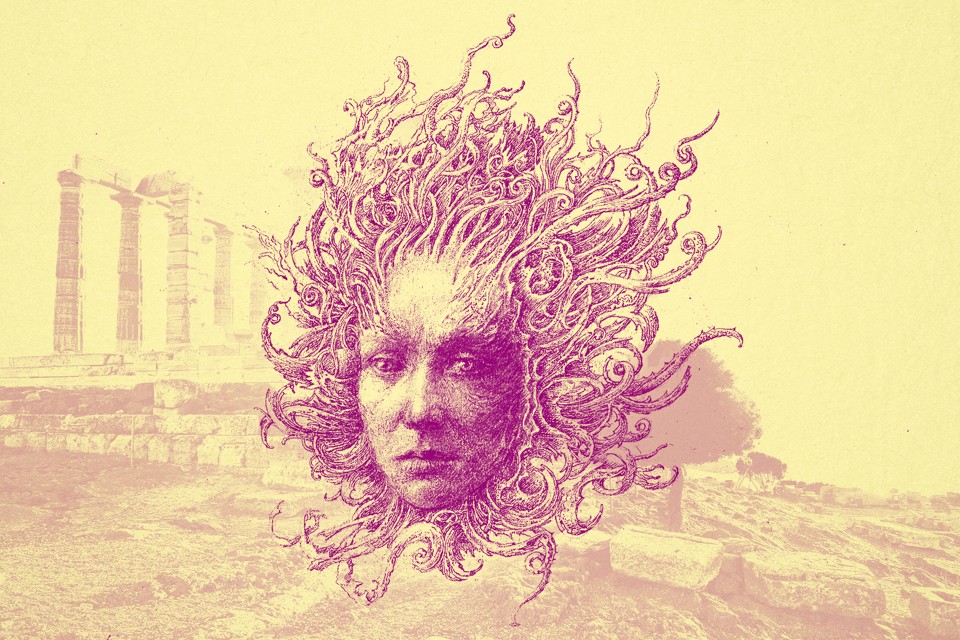
The Original ‘Nasty Woman’
For centuries, Medusa
has been used to criticize powerful women. So it’s no surprise the
mythological Gorgon has re-emerged this election cycle.
The Atlantic | 6 November 2016
As a professor of English, I teach a
humanities course on female icons in pop culture, and one of the first
examples my students learn about is Medusa. A Gorgon from classical
mythology, Medusa is widely known as a monstrous creature with snakes in
her hair whose gaze turns men to stone. Through the lens of theology,
film, art, and feminist literature, my students and I map how her
meaning has shifted over time and across cultures. In so doing, we
unravel a familiar narrative thread: In Western culture, strong women
have historically been imagined as threats requiring male conquest and
control, and Medusa herself has long been the go-to figure for those
seeking to demonize female authority.
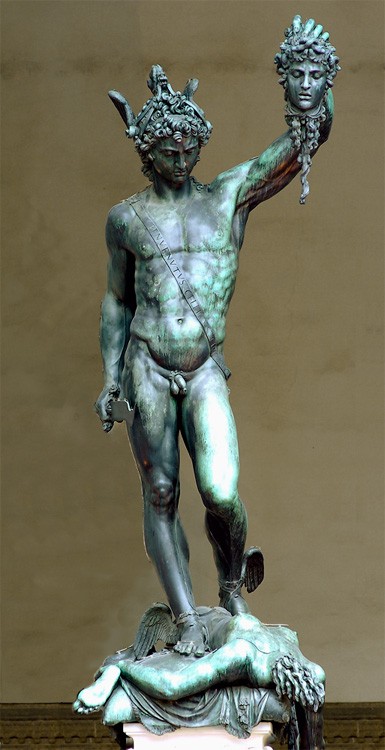
Perseus with the Head of Medusa.
Wikimedia
It’s perhaps no surprise, then, that Medusa has cropped up repeatedly during this heated election cycle, one that may end with the United States electing its first woman president. One image in particular keeps recurring—that of the Democratic candidate Hillary Clinton as the mythological snake-haired monster. Clinton has been compared to Medusa by conservative writers like Joel B. Pollak at Breitbart News and bloggers like Ron Russell at Right Wing Humor, and in political merchandise sold online. Meanwhile, her opponent Donald Trump has been portrayed as her conqueror, the Greek demigod Perseus. On Zazzle, people can buy products emblazoned with an image of a stoic Trump raising the severed head of a bug-eyed Clinton, her mouth agape in silent protest—an allusion to a sculpture by the Italian Renaissance artist Benvenuto Cellini. Today, the political references to Medusa only underscore the pervasive misogyny that drives many attacks against Clinton and other so-called “nasty women.”
Medusa
remains a potent icon at a time when women leaders continue to be
viewed skeptically or, at worst, as inhuman. Indeed, almost every
influential female figure has been photoshopped with snaky hair: Martha
Stewart, Condoleezza Rice, Madonna, Nancy Pelosi, Oprah Winfrey, Angela
Merkel. (Have a few minutes? Do a Google Image search: Type in a famous
woman’s name and the word Medusa.) These businesswomen, politicians,
activists, and artists made the same “mistake” that Susan B. Anthony
identified when she commented on the lack of women’s voices in
19th-century newspapers: “Women … must echo the sentiment of these men.
And if they do not do that, their heads are cut off.” These women
infringed upon the domain of men. The only response, as suggested by
their Medusa-fied images? To cut their heads off; to silence them.
The implicit violence of the Medusa comparison relates not only to beheading, but also to rape culture—another issue that has figured into the current election. Bits of Medusa’s story date back to at least Homer’s Iliad, but it’s with Ovid’s Metamorphoses that
her story emerges most fully. A closer read of her tale may surprise
those who only know her vaguely from popular culture. In Ovid’s story,
the god Neptune sees Medusa, desires her, and decides that, because he
is a god, he is entitled to her body (sound familiar?).
He rapes her in Minerva’s temple, and Minerva, incensed that her temple
has been defiled, punishes the victim rather than the perpetrator (again, sound familiar?).
Minerva transforms Medusa into a snake-haired monster who now, instead
of inspiring men’s desire, literally petrifies them. Later, Minerva
gives her shield to Perseus to help him kill Medusa; he uses it as a
mirror, deflecting Medusa’s curse. He beheads her while she sleeps and
then carries her head in a bag, a trophy he pulls out as needed to
destroy enemies.
Medusa has since haunted Western imagination,
materializing whenever male authority feels threatened by female agency.
As the art historian Christine Corretti has explained,
Cellini believed Medusa symbolized both the threat of women’s
burgeoning political power and a feminized Italy. Corretti notes that
these sentiments were popularized during the Renaissance by Machiavelli
who, in The Prince, alluded to the Medusa icon when he
described the state as a woman “without head, without order, beaten,
despoiled, torn,” desperate for a manly rescuer. Medusa again became a
symbol of a monstrously feminized republic during the French revolution.
In 1791, Marie Antoinette appeared as a beastly Medusa in the print “Les deux ne font qu’un.”
A year later the English artist Thomas Rowlandson created a print
depicting the vision of liberty espoused by the rebels of the French
Revolution as Medusa-like.

Later, as women’s colleges began to open in the United States, the 19th-century painter Elihu Vedder imagined Medusa
as a self-absorbed woman who petrifies herself by looking into a
mirror. Sigmund Freud notably used the myth to explain his concept of
castration anxiety. And as women rallied for the right to vote, various anti-suffrage postcards linked
suffragettes to the monster. Concerns about gender and power continued
into the 1940s when the writer Philip Wylie, in his invective Generation of Vipers, evoked
Medusa (and her Gorgon sisters Stheno and Euryale) in order to urge
readers to resist the women who had entered the work force after the
first two world wars. By then, Medusa’s history as a rape victim had
been erased from the cultural consciousness. She had simply become a
woman with a terrifying potential power to emasculate men.
However, with second-wave feminism,
many writers and artists began to re-examine traditional myth. Hélène
Cixous, Sylvia Plath, Colleen McElroy, and others searched the recesses
of history for their lost matriarchal heritage and chose Medusa as their
muse. “How to believe the stories I am told?” the poet May Sarton asked
in 1971 when she looked on the Medusa and found herself not frozen but
“clothed in thought.” Later, as discussions about rape culture evolved
in the 1970s and 1980s, poets including Ann Stanford and Amy Clampitt
channeled Medusa to engage in conversations about the silencing of
sexual-assault victims.
Similarly, feminist scholars like Marija
Gimbutas re-read the myth of Medusa as a beheading of early matriarchal
societies by Greco-Roman culture. According to this interpretation,
Neptune’s rape of Medusa and Perseus’s subsequent beheading of her
represent the same effort to legitimize male privilege by muting female
authority. Indeed, ancient mythology is rife with stories of gods who
violate women. This devaluing of women was reflected in the norms and
laws of a culture wherein women were traded as commodities between men
and rape was permissible by law.
When Medusa pops up in pop
culture today, her deeper significance is largely ignored. For example,
in the 2010 film adaptation of Clash of the Titans, Perseus
rallies his men before confronting Medusa: “I know we’re all afraid. But
my father told me: Someday, someone was gonna have to take a stand.
Someday, someone was gonna have to say enough! This could be that day.
Trust your senses. And don't look this bitch in the eye.” In the film,
Perseus knows Medusa has been raped, but she’s nonetheless treated with
indifference by the plot, and with hostility by the other characters.
With
this context, my students look anew on art like Cellini’s sculpture.
Now, they can see that Perseus is the aggressor, not a hero but a
symbolic rapist standing astride the body of his victim, her bloodied
head held high in victory. Medusa’s closed eyes and lips speak volumes
about both the history of women’s oppression and the submersion of
women’s histories. It’s a submersion poignantly symbolized by a story
that Congresswoman Carolyn Maloney shared recently at a panel discussion
in historic Seneca Falls, New York. For years Maloney tried to get a
statue of the first-wave feminists Elizabeth Cady Stanton, Susan B.
Anthony, and Lucretia Mott moved from the basement of the Capitol
Building to center stage in the Rotunda. Colleagues, however, argued that it was “too ugly.”
Women’s physical appearances are often particularly used as a way to
demean them, as the Clinton-Medusa images show, and tying women’s value
to their looks has also been a feature of this election thanks to Donald Trump.
The misogyny of the election comes through in much of the anti-Clinton
imagery that abounds, including a t-shirt featuring a beheaded Medusa
Clinton that reads, “Life’s a bitch, so don’t vote for one.” The shirt
echoes the campaign’s most popular slogan, “Trump that Bitch” (and even
the “bitch” quote from Clash of the Titans.) The fact that
there’s even a market for such political paraphernalia testifies to the
terror that powerful women continue to elicit even in the 21st century
and to the related and troubling persistence of mythologies that endorse
and perpetuate rape culture.
Unlike the eyes and mouth of the
Cellini Medusa, those of the Clinton Medusa in the Triumph t-shirt are
wide open, a grotesque caricature of female agency that likely gratifies
her conservative foes. Those satirizing Clinton as a Medusa are likely
unaware of the misogyny tied into the iconography. For them, Medusa is
just a creature who castrates men and that must be defeated. In their
minds, Hillary is monstrous, too, but in a slightly different way: She’s
a woman who wears pantsuits, who calls attention to institutional
sexism, who is ambitious, and who altogether refuses to conform to
traditional gender roles. And yet, as Greco-Roman history makes clear,
when the gods devalue women, the people will too. On Tuesday, voters in
the United States will decide which candidate they want as figurehead,
which representative they think best embodies the values of this
country. The implications of that choice could not be more profound.

No comments:
Post a Comment