

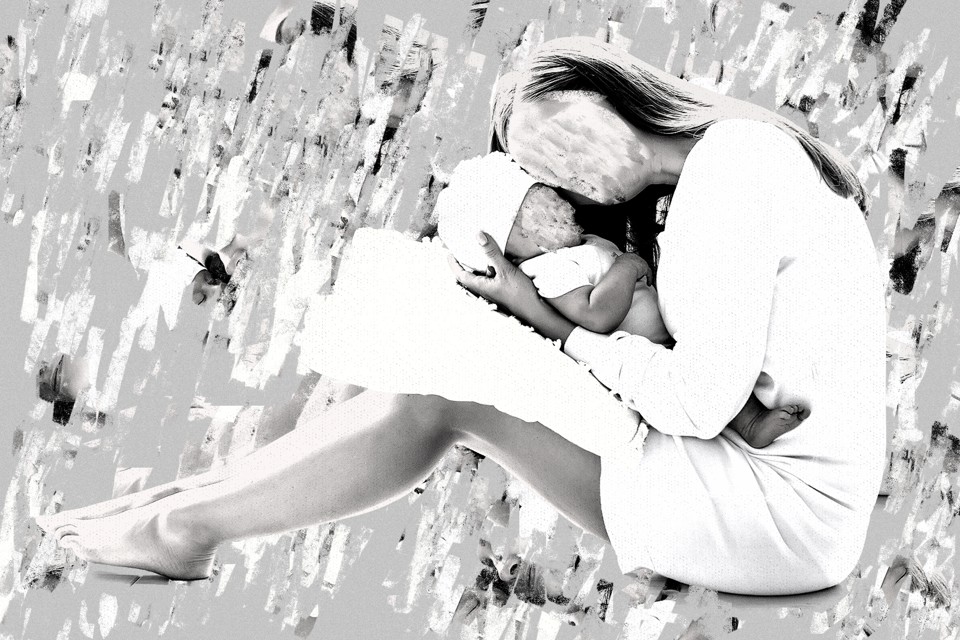
Traces of Times Lost
How childhood memories shape us, even after we've forgotten them
The Atlantic | 29 November 2016
The slippery baby in the plastic blue
tub cringes when her daddy, holding a drippy orange washcloth, leaks a
bit of water in her face. He is bathing her for the first time. “Make
sure you get the folds in her neck, where milk hides,” I say, video
recording the scene on my iPhone. We are new parents delighting in and
stumbling through this moment.
The three-year-old girl with pink
paint-chipped toenails watches my iPhone video of that day when Daddy
bathed her for the first time. She cringes as she sees her smaller self cringe. My daughter requested this clip out of more than 400, all
starring her, most of which she has watched before. We are snuggled up
on the sofa. Her eyes fixate on the feet of the squirming infant on
screen. She knows she was once that newborn. “Babies don’t get nail
polish,” she says, looking down to admire her toddler feet. “I’m a big
girl now.”
“Do you remember being a baby?” I ask, knowing it may be a trick question.
“Yes.” She is confident.
I want to peer inside her mind and see for myself what she thinks she remembers.
Many
psychologists used to believe that the brains of infants and toddlers
were not developed enough to embed salient long-term memories. That
notion began to change through the 1980s and 1990s with evidence
that even babies could learn and retain information over short
stretches of time. Questions remained: What kinds of memories endured?
What kinds were lost? How long could these early memories stick around?
And when and why did most eventually disappear for good?
Adults can rarely tap into recollections from before two—even memories of something dramatic
like a death, a birth, a hospitalization, or a family move. Most
memories, if they do survive, come to adults with more clarity if they
happened around or after age three-and-a-half. Still, not many that
happen between three-and-a-half and puberty survive throughout life.
Before we get into middle school most of the evocative impressions we
may have held onto from toddlerhood to elementary school have vanished.
As teens and adults, we are left with the stories we have heard about
being little, along with incomplete fragments of events (if any at all).
Only recently have scientists begun to understand the neurological
underpinnings of this inevitable loss.
A 2014 study in Science
found that throughout infancy, childhood, and into adulthood, new
neurons are born within a particular part of the hippocampus involved in
memory and forgetting. The researchers asserted that as the brain
continues to create these neurons—through a process called
neurogenesis—it must clear out older memories to make room.
Infantile amnesia has been studied for over a century, and there’s still much that’s unknown.
The
period of infancy to early childhood is one of the most crucial
stretches of one’s life for forming the self. Brain connections are
pruning and taking root. Lasting values are laid down. Foundations of
identity are instilled. Language and personality develop at rapid speed.
There is something bittersweet about the fact that we cannot access
that essential time from when we were small. When I think of my own
daughter, it is becoming harder for me to accept all that she will
forget.
* * *
This
week, she declares “fo-fo-felia” her favorite song (“Ophelia,” The
Lumineers), and insists on wearing a blue tutu when dancing to it. She
calls her dripping after-bath curls “mermaid hair,” grinning with a baby
gap in her front teeth. She likes to drink a cold cup of goat milk
before bed, and will not sleep without her Doc McStuffins doll. She has
named each of her other stuffed animals, listing them off while
arranging them in bed: Toodles, Sparkles, Wanda, Tukapua, Tukapia,
Layla, Nene, Mrs. Bumpers, and Milky Way Horse Face. Before falling
asleep, she wants to hold my hand.
No camera can capture the smell
of her at night: watermelon toothpaste and coconut hibiscus shampoo.
There is no iPhone camera recording these scenes, just the fragility of a
memory that will not last in her mind, at least in any accurate form.
Soon,
nights like these won’t be the same. The days of only us are dwindling.
Our boys will be here any minute now—my husband and I are expecting
identical twins. “My babies,” she calls her brothers with
anticipation. She doesn’t understand that they will demand more
attention than her parents will know how to give. People will stop and
gape at them, and overlook her. I hold onto videos to remind her, and to
remind me, that for three whole years, Mommy was all hers. I worry
about how her life after the twins will measure up to before. As her
memories recede, what will she lose?
Our memory is made of instances we know happened because outside sources told us so (Daddy once gave me a bath in a blue tub), and moments we revisit in our minds, looking out from our own eyes and bodies at an event we experienced in the past (I
feel the warm water on my belly. I see the blue tub and Daddy holding
the orange cloth. I feel like crying when the water gets on my face). That second kind—the ability to time travel into the past—is known as episodic memory.
Infantile amnesia—adults’ inability
to remember, in an episodic way, events from birth to early
childhood—has been studied for over a century, and there’s still much
that’s unknown. But what’s even more mysterious, and far less examined,
is how much kids remember their younger years while they’re still
children.
I know my daughter has strong recall for letters, words,
names, and songs. These skills fall into the category of semantic
(knowing) memory. When I interview her myself (totally unscientifically)
I feel like her episodic memory is pretty robust too. Six months ago,
someone broke into my locked car while it was parked at her preschool,
smashing the window and taking off with my purse, wallet, and phone,
which I had left inside in a rush to pick her up. On the ride home, I
explained to my daughter what the bad people did. A few weeks ago, out
of nowhere, she seemed to have a flashback while riding in my car along
the same route we took home after that burglary: “Remember the bad guys?
They broke your window? They stealed your bag, and your money, and your
phone.” It is obvious why that memory stuck. There was emotion in it,
and insecurity in the brief realization that the world is not always a
good place.
Sometimes, I am convinced my daughter
can visualize herself nursing in my arms, like she did as a baby. From
time to time, she curls up against me and tries to mimic the position. I
know she also recalls tunes of lullabies I sang putting her to sleep in
that first year of her life. But it’s hard to believe she could
mentally reconstruct a colorful scene from her infancy, at least without
the aid of a video.
According to a 2010 study in Developmental Psychology,
20 percent of children interviewed under age 10 remembered events that
occurred (and were verified by parents) before they even turned a year
old—in some cases even as early as one month old. These are provocative
findings. Yet Katherine Nelson, a developmental psychologist at City
University of New York who studied child memory for decades, tells me:
“It is still an open question as to whether and when very young children
have true episodic memories.” Even if they appear to, she explains,
these memories are fragile and susceptible to suggestion.
* * *
I
could tell you that my first childhood memory is from the day my
brother was born, when I was just shy of three. He was so delicate in my
mother’s arms, as I leaned over and introduced myself by kissing his
forehead. There is a photo from the hospital, so I can surmise what we
all looked like at that point in time. This short and sweet narrative
has been repeated by my parents so many times that it’s been integrated
into my long-term memory. But I don’t really recall any of it. I just know that it happened. I cannot mentally relive it in any honest way.
My
first actual episodic childhood memory feels quite different. I can put
myself back in that scene, in which I am three years old, floating
under water, sinking actually. I am heading toward a vent at the bottom
of a pool. I notice my body being pulled toward it. I am not scared of
drowning. I have no idea what that even means. Rather, I am filled with
wonderment and lightness. Suddenly a woman sweeps me into her arms. She
is wearing a swimming cap and goggles. I see my dad in the water,
rushing over to us.
“I just turned around or something
and all of the sudden you were gone,” my father says, when I ask him
about this event 35 years later.
“Was there a lady that picked me up?”
“She just kind of held you,” he says, “or yelled at me or something.”
“Did she have a cap on?”
“That I can’t remember.”
From
what my dad tells me, it was 1981. He had taken me on a road trip in
his 1965 Mustang from Illinois to New York, while my mother stayed
behind with my newborn brother. We were headed to meet his parents, who
were flying in from Japan. “I strapped you in the front seat,” he
recalls. We rode the whole 13-and-a-half-hour drive that way. After we
arrived at the New York hotel, he sat me on the side of the pool and
went for a quick swim nearby.
I hold in my memory hundreds of
poignant impressions of my father from my childhood—fishing, camping,
tumbling, watching him attempt to do the running man at a birthday
party. I recall segments of some. I have photos of others. Yet my
earliest episodic memory is not his finest parenting moment. Despite
this, I know that he cherished me, instilling values that stuck.
Thinking about this today makes me reconsider the role that episodic
memories in particular play in the foundation of our personalities.
Perhaps we have given this kind of recollection power too much credit
for its role in shaping our personalities, in making us who we are.
In
his book, “The Man Who Mistook His Wife for a Hat,” Oliver Sacks quotes
Luis Buñuel: “Life without memory is no life at all…our memory is our
coherence, our reason, our feeling, even our action. Without it, we are
nothing.” This has long been a commonly held belief, also spread by
philosopher John Locke, who maintained that memory is self. Some
research is now beginning to question this notion.
Not long ago, I interviewed and wrote
about the first person ever identified by scientists with a condition
called severely deficient autobiographical memory. She has no episodic
memories. Yet she maintains a clear personality, sense of humor, set of
beliefs, morals, hobbies, and pleasures. She lives a full life.
Last year, researchers from Yale University and the University of Arizona published a study in Psychological Science proclaiming that morality is more central to identity than memory. The authors studied patients with frontotemporal dementia (in which damage to the brain’s prefrontal cortex can lead to dishonesty and socially unacceptable
behavior), amyotrophic lateral sclerosis (also known as Lou Gehrig’s
disease, which affects muscle control), and Alzheimer’s disease (which
robs a person of memory). The research found that as long as moral
capacity is not impaired, the self persists, even when memory is
compromised. “These results speak to significant and longstanding
questions about the nature of identity, questions that have occupied social scientists, neurologists, philosophers, and novelists alike,” the authors write.
As
it turns out, the childhood memories we lose remain with us—albeit in a
different form, as the underpinnings of our morality and instincts.
This is what attachment theory
supposes, says Robyn Fivush, the director of the Family Narratives Lab
in the psychology department at Emory University. Infants who receive
sensitive and responsive caregiving grow up with a sense of the world as
safe, and themselves as lovable and loved. “No one really ‘remembers’
these early experiences,” she says “but they still have long lasting
impact.”
After my daughter’s first birthday, I uploaded all of her baby videos to a cloud service called StreamNation,
to save space on my phone. A year later, the site sent emails warning
customers to store media elsewhere because it was shutting down and
uploads would soon be deleted. Those memos got overlooked somewhere in
my spam. I didn’t realize all that I had lost until after the site
shuttered.
I sent frantic emails to the company. It did not reply.
From videos I had texted to my family, I managed to salvage a
smattering of clips, like the one with the blue bathtub. The rest from
that first year are gone.
Today, we offload
our memories to computer clouds, making them more fleeting than ever
before as our minds let go and allow technology to do the work of
retaining. By focusing on clicking photos or recording videos, we could
also be removing ourselves from the episodes we want to preserve,
blurring memories of these experiences. According to a study in the
journal Psychological Science, this is called “the photo-taking impairment effect.”
But videos can also enhance long-term memories, similar to what happens when family members frequently tell stories
to kids, says Jeanne Shinskey, of the Royal Holloway Baby Lab at the
University of London. “Enough repetitions could help consolidate the
original memory into a stronger trace that’s less vulnerable to
forgetting.”
By focusing on clicking photos or recording videos, we could also be removing ourselves from the episodes we want to preserve.
That
doesn’t mean the videos help them hold onto an episodic memory of the
event—rather, they may create a false memory. Recordings may lead
children to recall an event they actually “never remembered, but believe
they do,” says Michelle Leichtman, a professor of psychology at the
University of New Hampshire. “The child may search [his or her] memory
for the event representation and find it—but it’s not coming from the
original memory trace for the event, it’s coming from exposure to a
photograph, video, or story the child has heard about the event.”
Brian Levine, a senior scientist at
the Rotman Research Institute in Toronto, believes children do form true
episodic memories, but don’t retain them due to neurogenesis. “I don’t
think pictures or videos would have any effect on that,” he says. Videos
of being very young become part of a person’s semantic knowledge, not
episodic, similar to what happens with stories passed down by family.
They can include both false and true details.
So even if
StreamNation sent back every video of my daughter that I lost, once
childhood amnesia becomes permanent, for her, those visceral
recollections would still be gone.
* * *
On
a recent night, I sat at my daughter’s side as she babbled herself to
sleep, tucked beneath her comforter, nightlight aglow. Suddenly, I heard
her say: “We are all alive. We don’t die right?”
Where did that come from?
I thought. “Well, we all die sometime,” I replied, hoping that was not
too heavy for her age. “But we like being alive. So we’re going to try
to stay alive as long as possible right?”
“Right.”
At any age, it is hard to accept the idea of gone,
whether it refers to a life, an instant, a video, or a blip in time
when it was just us. Parents often become the bearers of our children’s
early lives, filling in the gaps for them, like spouses and friends do for each other. When you lose a loved one, part of your own life story passes away too.
Before
our boys enter this world I will try to steal more seconds alone with
my daughter, seconds that won’t be recorded. She will forget. Probably,
so will I. They will end up somewhere, lodged in our psyches—imprints we
no longer see.

Actually I had plenty of memory retained from age 2, 3 and 4.
ReplyDeleteAt age 2, I remembered being so small and young, I normally made my stool at the corner of the house over a piece of newspaper, then I called the adults to dump my stool away.
But then the dog in my house was so underfed and skinny, it tried to eat my stool as extra food. I was told to prevent the dog from eating my stool, but the dog was bigger than I was.
So, I was told to do my business between the door and the wall. I would sit face out and use the door and the wall as barricade. Well, guess what? Hehehe...
As I finished one of my business, I turned around to wrap the paper up so that I can dump my stuff away myself, the dog licked my butt. I clearly remembered screaming and shooing the dog away.
Such a golden memory from a poor boy, born into the cruel world. But I grew up just fine. All of my problems were fixed by the superior German American foster family. Chalalala...falalala...lalala.
At age 3, the girls next-door already chased me around. lol.. There were 5 girls, ages from 4, 7, 10, 13, 17 or so.... But that's another story for next time.
By age 4, I started playing chess on the street for extra food. I still remember a few disputes I had with the adults over the chess stuff.