

In a single decade, the omnipresence of media has rewritten the boundaries of public and private, exterior and interior.
Andy Crouch: The Return of Shame
From
online bullying to Twitter takedowns, shame is becoming a dominant
force in the West. Thankfully, the Bible is full of language about
shame. It's just that most Westerners don't see it.
CT is hosting a Twitter chat on Internet shame this Thursday evening. Share your experiences and feedback using the hashtag #CTshame.
Of the many new words that bubbled up from our technological culture in 2014, perhaps the most unsettling is doxxing.
Typically carried out by anonymous online users with axes to grind and
little to lose, doxxing involves making someone’s private information
public. That includes home addresses, phone numbers, financial
histories, medical records—anything that can be found in the endless
databases available to canny hackers.
Doxxing can be a drive-by prank on most anyone who draws attention. But more often its targets are singled out for humiliation. In a series of events last year that came to be called GamerGate, certain active video gamers targeted journalists, mostly women, who had criticized the outright misogyny found in many popular video games. The backlash began with the bilious insults that have become astonishingly common online. But it quickly escalated to “revenge blogs” purporting to reveal those journalists’ past indiscretions, and doxxing attacks.
Doxxing is extreme and rare. But it marks the limit of a trend that
affects every one of us: aspects of our lives that were once private and
fleeting can now be publicly, and permanently, exposed.
An American 13-year-old today has never known a day without the
Internet, mobile technology, and social media. He or she started
kindergarten the year the iPhone was released and Facebook opened its
site to the public. In a single decade, the omnipresence of media has
rewritten the boundaries of public and private, exterior and interior.
Chap Clark, chair of the youth, family, and culture department at Fuller
Theological Seminary, points out that it used to be that high-school
students “would leave school and go home, and could leave that
high-pressure atmosphere behind. Now, with smartphones and tablets, kids
take that social environment into their bedrooms.”
'On Facebook, others’ perceptions of us are both public and relatively permanent.... People tag you, people talk about you. And if no one comments, that can be just as much a source of shame.' ~ Kara Powell, Fuller Youth Institute
Clark’s colleague Kara Powell, executive director of the Fuller Youth
Institute, recalls a moment of shame from her adolescence. “There were
maybe five kids sitting in a car across the street,” she says,
recounting how she tripped and fell. “I remember them laughing at me as I
picked myself up. But that was in front of five kids, and it was over
in five minutes. Today, if someone caught a moment like that on a
smartphone and shared it on social media, that shame could live with the
kid for the rest of high school.
“On Facebook, others’ perceptions of us are both public and relatively
permanent,” Powell says. “You post something and everybody comments on
it. People tag you, people talk about you. And if no one comments, that
can be just as much a source of shame.”
The personal screen, especially with its attached and always-available
camera, invites us to star in our own small spectacle. As our social
network chimes, blinks, and buzzes with intermittent approval, we are
constantly updated on our success in gaining public affirmation. But
having attracted us with the promise of approval and belonging, the
personal screen can just as easily herald exclusion and hostility, as
the targets of GamerGate found out and as nearly every teenager in the
West knows from experience.
And oddly enough, this contemporary fusing of public and private is
reconnecting us to one of the most striking features of cultures we
consider traditional and premodern: the importance of shame.
Traditional Shame
Despite his name, Jackson Wu’s ancestors lived in East Texas, far from a
traditional Asian background. Yet his upbringing in the American South,
a culture that he says “emanates ‘honor and shame,’ ” prepared him well
for his current work.
Wu now lives in an industrial city in China, where he is known by
another name altogether. To many of his neighbors there, Wu is just one
more expatriate professional. But Wu is in an unusual line of work: He
teaches theology at a seminary in a country with perhaps 90 million
Christians yet relatively few theologically trained pastors. China
rarely gives Westerners a visa for this kind of work, so Wu uses several
layers of pseudonymity to protect him, his family, and his students
from unwanted official attention.
We meet on the campus of Houston Baptist University, where Wu is
speaking to the International Orality Network (ION). ION convenes
Western missionaries and academics, as well as indigenous church leaders
from several continents. These leaders serve the 70 percent of the
world’s population (5.7 billion people) who can’t or don’t hear the
gospel when it is presented in written words via books or pamphlets. But
the first day of this year’s meeting is devoted to honor and shame, one
of the hottest topics in contemporary mission theory and practice.
Wu has just published his dissertation from Southeastern Baptist Theological Seminary, titled Saving God’s Face: A Chinese Contextualization of Salvation through Honor and Shame.
He argues that the whole Bible, including no less central a text than
Paul’s letter to the Romans, is saturated with themes of honor and
shame. It's an understanding of morality and community that permeates
every aspect of Chinese culture.
I’ve come to eavesdrop on this missions conversation because I suspect
that honor and shame are becoming dominant forces in the American
context. If so, effective evangelism and discipleship in the next
generation will require learning from cultures where shame, far more
than guilt, is the human problem the gospel must address.
Western versus Eastern Shame
The idea of “shame cultures” originated with anthropologists. During
World War II, Columbia University anthropologist Ruth Benedict was
trying to make sense of the cultural patterns of the Japanese. Her 1946
book, The Chrysanthemum and the Sword,
popularized the idea that Japan was a “shame culture,” in which morality
was governed by “external sanctions for good behavior.” In other words,
you know you are good or bad by what your community says about you. By
contrast, in a guilt culture such as the West, you know you are good or
bad because of an “internalized conviction of sin”—by how you feel about
your behavior and choices.
In hindsight, Benedict’s analysis was too tidy and sweeping. But her
essential insight—that some cultures place a higher priority on
preserving honor and avoiding shame—has remained. It’s what many Asian
cultures call face, and missionaries like Wu believe it describes
something Westerners have tended to overlook.
“Shame,” in recent years, has become a topic of conversation in the
West. Poignantly described by psychologists and authors like Dan
Allender and Brené Brown, shame in this context describes an inner sense
of unworthiness, often rooted in trauma and embarrassing experiences.
Though real, this sort of shame is psychological and deeply interior. A
respected scholar like Brown can testify to struggling with hidden
personal shame, no matter how favorably she is viewed by others.
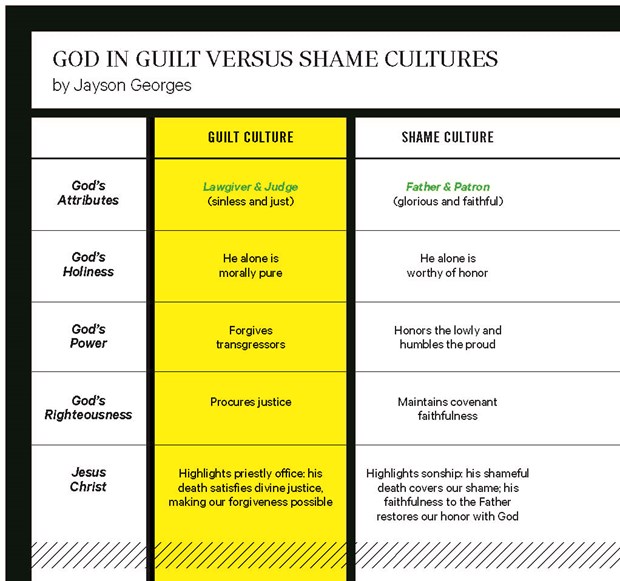
But in traditional cultures, shame is a thoroughly public reality. “The
opposite of Western shame is self-esteem—I feel good about myself,”
American missionary Jayson Georges (a pseudonym) writes at his website, HonorShame.com.
“The opposite of Eastern shame is honor—others thinking highly of me.”
In this latter sense, shame is always seen and recognized by the
community. Social shame, as well as honor, is all too obvious to all
concerned.
In a shame culture, you know you are good or bad by what your community
says about you. By contrast, in a guilt culture, you know you are good
or bad by how you feel about your behavior and choices.
Everyone who studies honor–shame cultures today is quick to point out
that both shame and guilt are universal human experiences. So is the
desire for their opposites: honor and innocence, where honor is a public
affirmation of worth and innocence is a sense of conformity to an
internalized moral ideal.
Further, both Westerners and Easterners experience both private and
public forms of shame. But there is little doubt that some cultures pay
far more attention to dynamics of honor and shame than Westerners do—or
at least, than Westerners used to.
Individualistic Shame
To be sure, the new, media-amplified shame culture is different from
traditional cultures built on honor and shame. Georges, who has spent
most of his adult life in a traditional culture in Central Asia,
expressed polite incredulity when I suggested that the West was becoming
more shame-oriented. If anything, Western culture has become more
individualistic over the past generations, as seen in the continuous
unraveling of ties to family and local institutions. Bestowing and
maintaining honor requires the kind of binding community that Western
mobility and personal freedom are practically designed to dissolve.
So instead of evolving into a traditional honor–shame culture, large
parts of our culture are starting to look something like a postmodern
fame–shame culture. Like honor, fame is a public estimation of worth, a
powerful currency of status. But fame is bestowed by a broad audience,
with only the loosest of bonds to those they acclaim.
Some of the most powerful artifacts of contemporary culture—especially
youth culture—are preoccupied with the dynamics of fame and shame. The
Hunger Games trilogy draws on the legend of Theseus and the young
“tributes” sent by vassal states to ancient Crete. The Theseus legend is
firmly set within a traditional honor–shame culture. But whereas
Theseus and his fellows confronted the Minotaur alone in the depths of
the Labyrinth, an ocean away from their families and homes, Katniss
Everdeen and her fellow tributes in the Hunger Games make every move
under the ruthless gaze of the nation of Panem’s mediated culture of
spectacle. They are accompanied by the retinue of handlers, coaches, and
wardrobe designers that surround our celebrities. Indeed, the power of
the trilogy is that it centers on a young woman trying to maintain
goodness and honor in a world that seems to offer only fame and shame.
Because fame-oriented culture lacks the traditional structures of
community and honor, those in it dread being excluded or shamed. In a
traditional culture, when someone experiences shame, a web of people
will try to restore lost “face.” Indeed, many honor–shame cultures
strive to prevent the loss of face in the first place. Conflict that
would be tolerated in a guilt–innocence culture is suppressed or
redirected in order to prevent ruptured relationships—one reason that
many honor–shame cultures prize politeness and indirectness in
situations in which disagreement could erupt.
But our fame–shame culture has few broad norms enforcing politeness or
concern for the “face” of others, as the most glancing encounters with
social media, let alone a full-on GamerGate-like assault, will confirm.
In fame–shame culture, people yearn to feel included in the group, a
state constantly endangered, fragile, and desperately in need of
protection.
Sex and Shame
This dynamic plays out powerfully in North American Christian views of
human sexuality. Older Christians likely remember the way violating the
prevailing moral code (by, say, pregnancy outside of marriage or
homosexuality) once brought public shame. But even 50 years ago, sexual
ethics still tended to be framed in terms of moral right or wrong, not
in terms of mere social approval or disapproval.
But North Americans, including Christians, increasingly frame their
sexual ethics in light of a paramount concern for social inclusion or
exclusion. In a fame–shame culture, the only true crime is to publicly
exclude—and thus shame—others. Talk of right and wrong is troubling when
it is accompanied by seeming indifference to the experience of shame
that accompanies judgments of “immorality.”
Christians point out Jesus’ willingness to welcome those excluded by
traditional society: tax collectors, lepers, and beggars, not to mention
women in general. (Jesus’ pointed and public exclusion of whole towns
and districts that yawned at his message, not to mention his own mother
and brothers, gets less attention.)
So attempts to reiterate traditional Christian sexual ethics fall not
on deaf ears, but on ears highly attuned to dynamics of shame and
rejection. It is no coincidence that the student groups that are
pressing for revisions to codes of sexual conduct on Christian campuses
have chosen the prefix “One” (as in OneWheaton and OneGordon). They are
emphasizing the unity of the community, including those who have been
excluded as sexual minorities. “OneWheaton” is a different kind of
appeal than “True Wheaton” would be. It is a name perfectly calibrated
to the new realities of fame–shame culture.
Shame-Filled Opportunity
Christians formed by guilt–innocence cultures are tempted to deal with
such concerns by denying their premise. Isn’t the gospel really about
guilt before God and forgiveness by him through his Son? If so, the
first order of business when encountering people preoccupied with honor
and inclusion is to make the case that guilt and forgiveness are the
deeper human problem and need.
But the new generation of missionaries, like Wu and Georges, and
Christian leaders now arising from honor–shame cultures, see honor–shame
culture not as a hurdle to overcome but as an opportunity to grasp the
Good News more deeply. After all, the message of Scripture was delivered
within two unmistakably honor–shame cultures. Both the ancient Near
East, where Israel came into existence, and the Greco-Roman world, where
the early church arose, were saturated with concern for honor and an
aversion to social shame.
At the beginning of the story of Israel in Genesis 12, God does not
promise to make Abraham morally good—he promises to make his nation and
name “great,” a far more central concern in Abraham’s cultural context.
As Simon Chan observes in Grassroots Asian Theology, “There is more said
in the Bible about shame and honor than there is about guilt and
innocence.”
Even the Bible’s language of God’s “glory” is all about public worth:
the One worthy of greatest honor, who is due proper recognition and
adoration. The biblical idea of “justification,” Wu and others argue,
always involves a public dimension, not just an interior or individual
one. (This is why God can be said to be “justified,” even though God
does not do wrong—there is still the question of whether God will be
seen as acting honorably by human beings.) In Romans 1, the apostle Paul
makes the central claim that humans have neglected God’s glory and
disordered God’s purposes for the world. The chapter is saturated with
honor–shame language, as is Romans 8, the great statement of God’s plan
to “justify” and “glorify” those who are saved through faith.
When Wu became a Christian, he turned to the writings of John Piper and
Jonathan Edwards. “They stressed ‘the glory of God’ above all things,”
he said. “I realized not only the importance of honor–shame in the
Bible; I also realized how well these ideas worked out in a Chinese
context. The basic principles of honor–shame are pretty consistent
across cultures. The exact rules of the cultures may vary, but the
fundamental values are similar.”
“Honor–shame dynamics are intrinsic to the gospel,” missionary
executive Werner Mischke told the ION attendees, “not just a lens we put
on to make the gospel understandable to oral cultures. When we read the
Bible’s emphasis on honor and shame, we are taking our Western lenses
off to see what’s actually there.”
When we take those lenses off, we begin to see the hope Scripture
offers to a world preoccupied with shame. It is hard for us to grasp how
terrifying and shaming it would have been for Paul’s communities to
learn that their apostle was in prison, that the Roman state was heaping
public shame upon their representative. We cannot fully imagine how
devastating this would be, because we have been converted to a new way
of thinking by Paul himself. He hastens to assure his friends in
Philippi that against all their expectations, “what has happened to me
has actually served to advance the gospel” (1:12). Later in the same
letter, Paul even more comprehensively reconfigures the honor–shame
imagination, listing all his reasons for honor (both ascribed and
achieved) and then declaring that those all are “rubbish” when compared
to knowing and serving the crucified Messiah.
Mischke, Wu, and others emphasize that guilt and forgiveness are real
biblical themes because guilt, just like shame, is a universal human
reality. But they and other missiologists call attention to all the ways
that the gospel addresses both our guilt and our shame.
The cross, after all, was far from just an instrument of execution.
There were many ways for the Roman legal system to practice capital
punishment. But the cross was specifically designed to maximize victims’
shame, from the whipping along the route to the place of crucifixion,
to the stripping of every article of clothing (even though Western art
has often shied away from portraying this brutally humiliating aspect of
Jesus’ final hours), to the hours or days of exposure to the elements
and the mocking of passersby.
Given the rushed and shoddy legal process that led to Jesus’
conviction, observers along the road to Calvary would have had every
reason to doubt his guilt. But no one would have doubted his complete
and utter shame—and seen his followers as under just as much threat of
punishment and exclusion. No wonder most of them scattered and fled.
From Fame to Honor
The remedy for shame is not becoming famous. It is not even being
affirmed. It is being incorporated into a community with new, different,
and better standards for honor. It’s a community where weakness is not
excluded but valued; where honor-seeking and “boasting” of all kinds are
repudiated; where servants are raised up to sit at the table with those
they once served; where even the ultimate dishonor of the cross is
transformed into glory, the ultimate participation in honor. To use the
powerful biblical metaphor, the gospel offers adoption—a new status as
“sons,” to use the intentionally gendered, high-status word of Romans
8—to both men and women, now members of the family of the firstborn Son.
The remedy for shame is not affirmation. It is incorporation into a community with new, different, and better standards for honor.
Of course, putting this good news into practice takes pastoral courage
and creativity. In the pastoral letters of the New Testament, we see
Paul and other church leaders reframing the traditional categories of
honor and shame. The task of the early church, as Mischke puts it, was
to free its members from “honor competition” and give them high “shame
resilience.” This would enable them to endure low status in the Roman
world while reaching out to those no one else would touch. At the same
time, the apostles followed Jesus in drawing clear, if countercultural,
boundaries for inclusion and exclusion, calling members of this new
community to the holiness that brought honor to God.
“I’ve been meditating on Psalm 31:1,” Powell told me. “ ‘In you, Lord, I
have taken refuge; let me never be put to shame; deliver me in your
righteousness.’ It is the righteousness of Jesus that we long for. This
is a universal part of the human condition.”
The beauty of the gospel is that it acknowledges guilt and shame,
covering both with the shame- and guilt-bearing representative Son. What
honor–shame cultures are offering to missionaries, our own fame–shame
culture may offer as well: a chance, in the depth of both our guilt and
our shame, to discover just how completely good that news can be.
Andy Crouch is executive editor of Christianity Today.

No comments:
Post a Comment