

 |
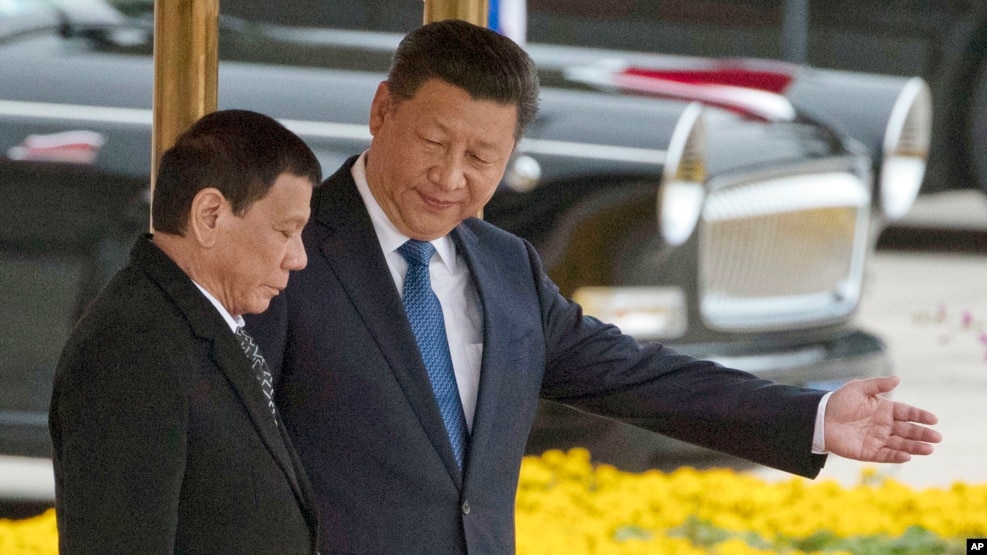
| FILE - Chinese President Xi Jinping, right, shows the way to Philippine President Rodrigo Duterte during a welcome ceremony outside the Great Hall of the People in Beijing, China, Thursday, Oct. 20, 2016. (AP Photo/Ng Han Guan) |
Philippine President Duterte Joins Cambodia in Asean’s Growing Pro-China Bloc
VOA | 8 November 2016
Manila’s realignment would have negative consequences for US
influence in the Asean region diplomatically and economically, analysts
said.
PHNOM PENH — When Philippine President Rodrigo Duterte announced in China that
“America has lost me,” he became the most recent leader within the
10-member Association of Southeast Asian Nations (Asean) to align with
Beijing.
Duterte went one better in his speech on October 20 in China, proposing
that an alliance between Manila, Beijing and Moscow could follow now
that he had announced his “separation from the United States.”
A long-time ally of the US, Duterte’s decision to swing Philippine
foreign policy 180-degrees from Washington and into Beijing’s
“ideological flow,” followed international criticism of his
shoot-to-kill policy in a so-called war on drugs that has left thousands
of low-level dealers and drug users dead in his homeland.
Duterte’s move toward Beijing marks the third Asean member, along with
Cambodia and Laos, to hitch their foreign policies and their fortunes to
the promises of an emerging China, particularly Chinese investment,
condition-free aid and lots of low-interest loans.
Scholars interviewed by VOA Khmer said Manila’s cozying-up to China
might provide “short-term benefits,” including the Philippines avoiding
conflict with China over maritime claims in the South China Sea.
However, Manila’s realignment would have negative consequences for US
influence in the Asean region diplomatically and economically, analysts
said.
“If you can’t beat China, you should join China. I think [Duterte’s]
also following the golden rule: whoever has the gold makes the rules,”
said Ear Sophal, an associate professor at the Occidental College in Los
Angeles, California.
Describing Duterte as “wily”, Sophal said the Philippines president
appears to have followed the example of Cambodian Prime Minister Hun
Sen, who has long vowed loyalty to Beijing and has often done China’s
bidding within Asean on the South China Sea issue.
In return, Hun Sen has received billions in loans and investment from
China, eclipsing more traditional aid donors such as Japan and Western
countries who have sometimes sought promises of governance reforms in
return for financing and development assistance.
“Duterte is definitely learning from the master himself, PM Hun Sen,” Sophal told VOA Khmer in an emailed response to questions.
During his visit to China in October, when he made his vow of support,
Duterte also signed 13 bilateral agreements with Beijing, including
trade agreements and financial assistance worth around $13.5 billion to
the Philippines.
“It’s a natural move,” said Kung Phoak, president of the Cambodian Institute for Strategic Studies (CISS).
“The economy of any Asian country depends on China’s trade and
investment, as do the Philippines or Cambodia,” Phoak told VOA Khmer.
John Ciorciari, professor of public policy at the University of
Michigan, said the Philippines’ realignment to China would be welcomed
by Cambodia, which is now not the only openly pro-Beijing government in
the Asean region.
“Duterte surely hopes for economic benefits from a closer relationship with China,” Ciorciari told VOA Khmer.
“For Cambodian leaders, a less assertive Philippine position on the
South China Sea and a weaker US-Philippine alliance may be welcome in
the short term, because it may lessen the tension with Asean over how to
address China’s advances in the South China Sea,” Ciorciari wrote by
email.
Longer term, however, “He [Duterte] is setting the country on a dangerous path,” Ciorciari said.
Cambodia is much further along its own path with China, particularly on the South China Sea dispute.
In 2012, an Asean foreign ministers’ summit in Phnom Penh failed to
produce a joint statement for the first time in the association’s
45-year history after Cambodia blocked any critical mention of China
regarding tension in the South China Sea dispute.
Cambodia showed its loyalty to Beijing once again when it blocked yet
another joint statement at the annual Asean meeting in Laos in July.
The Asean communiqué in Laos had included in draft form a reference to
the UN Permanent Court of Arbitration, which had recently ruled in favor
of the Philippines and against China in the South China Sea dispute.
The case was brought to The Hague court in 2013 by Manila following
tension with China over contested areas around the Spratly and Paracel
islands.
China rejected the court ruling outright. Cambodia had received $600
million in aid and loans from China just prior to the Asean summit.
During a visit to Cambodia last month, Chinese President Xi Jinping
wrote off about $90 million in debts, and pledged another $230 million
in loans to the Hun Sen government, including $15 million in military
aid.
China has provided around $15 billion in aid and loans to Phnom Penh
over the past 20 years. That figure does not include the 1970s and
1980s, when Beijing was the primary donor to the Khmer Rouge government
in Phnom Penh and when it was an armed faction in exile on the Thai
border.
China will not immediately trust that the Philippines has changed
foreign policy camps, and it will want to more than words of support
from Duterte, said Sophal of the Occidental College.
“I expect that the Philippines will be a recipient of more Chinese
assistance. But these things take time. It’s not like China is going to
suddenly give the Philippines billions,” he said.
“China’s relationship with Cambodia is very special. Decades in the
making. Plus, remember the Khmer Rouge? Anyhow, China is not stupid.”
More immediately, the Philippines’ move gives China more influence in Asean.
“It obviously means Asean will be less interested in making statements against China,” Sophal said.
Despite Duterte’s much publicized comments on breaking away from
Washington in favor of China, the US State Department maintained last
week that it had not received any official separation letter from
Manila.
Speaking at a news conference in Phnom Penh on October 27, Assistant
Secretary of State for East Asian and Pacific Affairs Daniel Russel said
Washington respected Duterte’s decision, and the independence of the
Philippines in matters of foreign policy.
Russel said the Philippines turning to China did not reflect the failure
of President Barack Obama’s “rebalance to Asia” policy, adding that the
rebalance could not be labeled with terms such as “success or failure.”
Ups and downs in bilateral relations are not a “verdict on the value of the American engagement,” Russel said.
Some believe that it is US engagement with Asean that might suffer the
greatest following Duterte’s swing to Beijing, which seems likely to
provide China more influence in Asean,
“The US security relationship with Philippines is a key pillar of the
strategic architecture in Southeast Asia,” said Ciorciari, of the
University of Michigan.
“If it cracks, wobbles or collapses, Asean states that see the US presence as helpful will have to adjust.”

No comments:
Post a Comment