With the Cold War ending, it was time to extricate foreign powers, and as Mr Carney puts it, "put politics back into Cambodian hands".
But ultimately the guerrillas boycotted the polls, choosing instead to ambush peacekeepers and carry out attacks. The run-up to the vote was also marred by a massive campaign of violence and intimidation carried out by Hun Sen's Cambodian People's Party (CPP). He had been the presiding force in Cambodia during the latter years of the Vietnamese occupation and this was a taster of the coming decades, said Mr Carney.
"There wasn't much doubt", he said, that Hun Sen and the men around him would seek to hold onto power at any cost.
 |
| PETER CHARLESWORTH/GETTY IMAGES |
In 1993, the UN tried to bring democracy to Cambodia. Is that dream dead?
BBC News | 28 July 2018
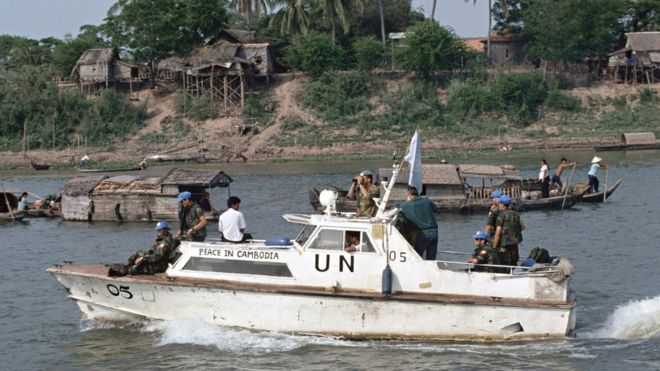
In the early 1990s, the international community - through what was then the largest-ever UN peacekeeping operation - made an idealistic attempt to remake broken, war-ravaged Cambodia into a functioning liberal democracy.
Twenty-five years later, Hun Sen, the man who ran the country before the UN arrived, remains in charge and Cambodia is on the eve of a one-sided election widely seen as marking the end of that era.

Sophorn understands the value of a free vote. His early years were spent in a children's work collective during the brutal Khmer Rouge regime, a four-year reign of terror in which some two million people died, including his own father. He muddled through school after Vietnamese forces toppled the radical Maoists and occupied his country.
Then in 1992, when he was in his last year of high school, the UN's blue helmets arrived in Cambodia. He stumbled into the international peacekeeping mission after using his rudimentary English to help an Indian officer and his wife buy things at a market in rural Prey Veng province.
"It was the first time that I could talk English with a foreigner in my life," he said. "He asked me, 'would you like to work for Untac [the UN Transitional Authority in Cambodia]?'"
More than 20,000 military, police and other personnel of all nationalities had flooded Cambodia, which had been largely cut off from the outside world since 1975. The international contingent was there to do something the UN had never done before: take control of an independent state's administration and set up and run national elections. It was also meant to help bring about a ceasefire between the various warring factions, disarm their forces and repatriate thousands of refugees languishing in camps on the Thai border.
 PETER CHARLESWORTH/GETTY IMAGES
Tens of million of dollars poured into one of the world's poorest countries, sending inflation soaring. Thousands of women entered [trucked into Cambodia from Vietnam into] the sex trade due to the arrival of UN personnel, and HIV/AIDS infections spiked.